
AD 1000 to 1500
How population, northern networks, technology and war changed the balance of power
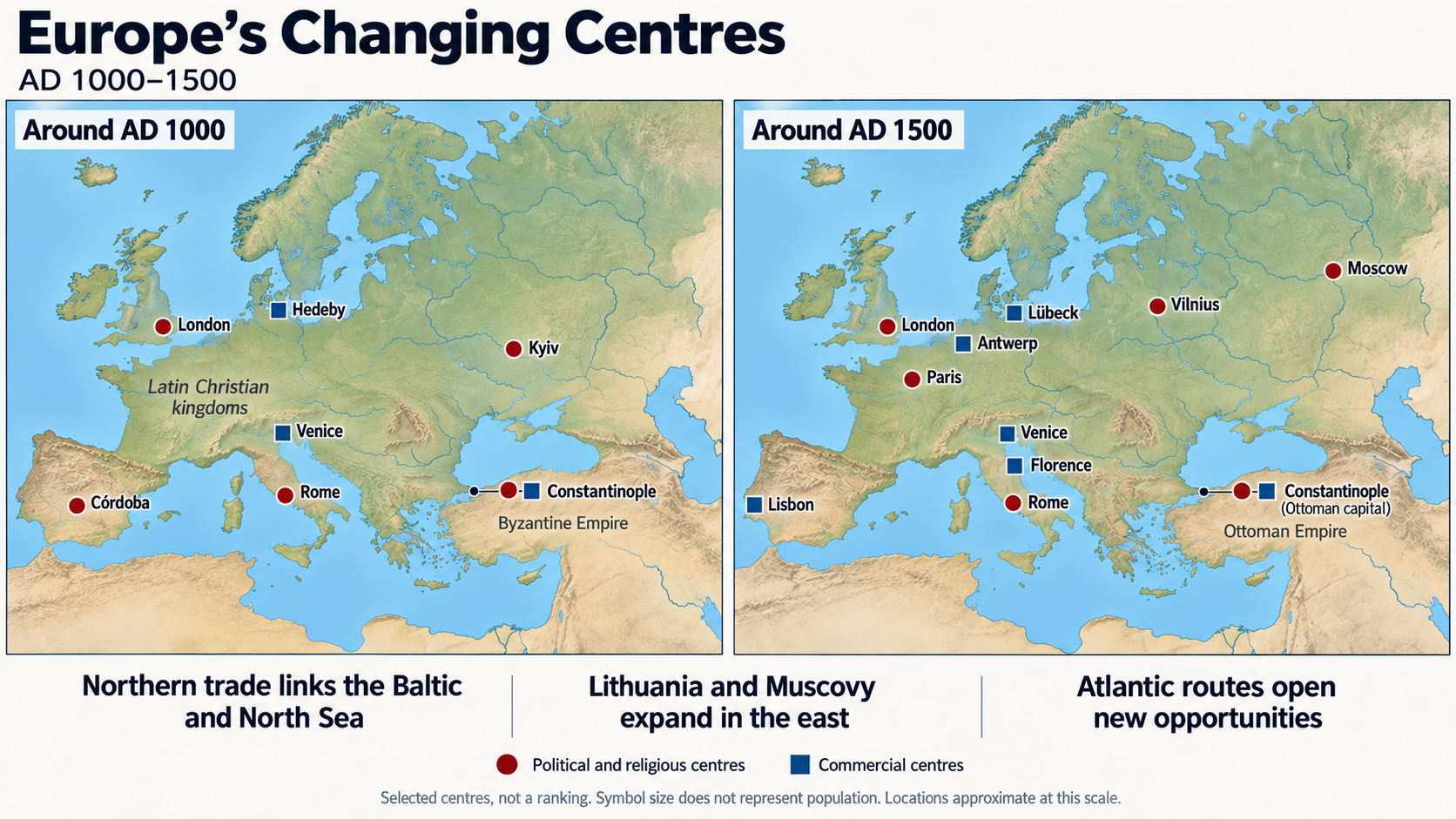
Europe around AD 1000 had no single capital, people or political system. Constantinople connected the Mediterranean to the Black Sea. Kyiv linked the Baltic to Byzantium. Scandinavian fleets crossed the North Sea, while agriculture supported most of the continent’s population.
Over the next five centuries, more people, larger markets and new technologies helped cities and states grow. Then invasion, famine, plague and war overturned parts of that expansion. Some centres declined; others gained influence through trade, taxation, conquest or improved access to information.
By 1500, Italian cities and the Low Countries formed major commercial concentrations. Poland-Lithuania and Muscovy were expanding in the east. Constantinople had become an Ottoman capital, and Portugal and Castile were opening Atlantic routes. This was the transition from the High Middle Ages to the Late Middle Ages and, unevenly across Europe, towards the Renaissance and early modern period.
Population figures below are historical estimates, not modern censuses. Regional boundaries and methods differ. Dates establish the sequence; population, production and network figures indicate scale where the evidence allows it.
A growing continent with several centres
The expansion after 1000 began largely in the countryside. New villages, cleared woodland and drained land supported more households. Agricultural surpluses then sustained craftsmen, merchants, clergy and officials who did not grow all their own food.
Paolo Malanima’s reconstruction places Europe’s population at roughly 47 million in 1000 and 94 million in 1300. Its regional estimates show different recovery paths after the fourteenth-century crisis. Values for 1000 are especially uncertain because they are largely reconstructed backwards from later estimates. [1]
Estimated population in millions
| Historical region | 1000 | 1300 | 1400 | 1500 |
| Scandinavia | 1.1 | 2.5 | 1.4 | 1.5 |
| France | 8.4 | 16.0 | 12.0 | 15.0 |
| Italy | 5.8 | 12.5 | 8.0 | 9.0 |
| German lands | 4.5 | 13.0 | 8.0 | 11.0 |
| Poland | 0.9 | 2.0 | 1.5 | 2.0 |
| Balkans | 3.6 | 6.0 | 5.0 | 5.5 |
| European Russia* | 8.5 | 15.0 | 11.0 | 15.0 |
| Europe total | 47.1 | 93.6 | 67.9 | 84.9 |
Source: Malanima, Table 2. Values are rounded. Historical regions follow the source and differ from current borders. *European Russia is the source’s geographic category, not a claim about medieval political sovereignty. [1]
In this reconstruction, Scandinavia fell from about 2.5 million in 1300 to 1.4 million in 1400, while Italy fell from 12.5 million to 8 million. By 1500, neither had regained its earlier level. Poland had returned to approximately its 1300 estimate. These differences affected labour supplies and markets, but population alone does not explain a region’s political success. [1]
The geography of growth mattered. Northern Italy combined productive countryside with dense urban networks. Flanders specialised in cloth, using wool imported from England. The Rhineland connected inland production to river transport, while northern ports drew Scandinavia and the Baltic into larger markets.
Growth did not mean that Europe became predominantly urban. Most people still depended on agriculture. But more people could now concentrate in towns, and towns could collect income from a much larger hinterland. Commerce and government began to reinforce each other.
Scandinavia and Britain from conquest to kingdoms
Around 1000, Scandinavian activity still combined trading, migration, raiding and attempts to rule overseas territories. “Viking” describes activities and historical communities rather than a single unified nation. Denmark, Norway and Sweden were developing monarchies whose rulers increasingly used Christianity, law and taxation to secure power.
The most striking western achievement was Cnut’s rule over England from 1016, Denmark from 1018 and Norway from 1028. For a period, three kingdoms were connected across the North Sea. English revenues, coinage and administration supported a monarchy operating on both sides of that sea. [2]
This northern political complex proved fragile. Cnut died in 1035, and Scandinavian rule in England ended in 1042. Norwegian influence nevertheless continued around Scotland and the northern islands. In 1066, Harald Hardrada invaded England and was defeated and killed at Stamford Bridge on 25 September. Less than three weeks later, William of Normandy won at Hastings on 14 October. [3]
Contemporary chronicle versions describe Harald’s fleet as about 300 ships. This is a reported medieval figure, not a verified fleet register. It indicates the scale contemporaries associated with the expedition; precise troop totals remain uncertain. Harald’s defeat weakened the immediate Scandinavian bid for England, while the Norman conquest redirected English aristocratic and dynastic connections towards France. [3]
The northern contribution did not end with the Viking Age. Scandinavian settlements, place names, maritime connections and language contacts remained part of British society. The balance changed from repeated overseas conquest towards stronger kingdoms and continuing regional trade.
The eastern route from Sweden to Kyiv and Constantinople
Scandinavians also travelled east from the Baltic through river systems towards the Black Sea and Caspian Sea. The Dnieper corridor led through Kyiv to Constantinople; the Volga connected travellers to markets linked with the Islamic world. Furs, wax, enslaved people and silver were important parts of these exchanges. Local Slavic, Finnic and other communities supplied knowledge, labour and political connections essential to making the routes work. [4]
These networks largely predated 1000, but their effects continued into the eleventh century. Scandinavian warriors and merchants participated in the formation and ruling networks of Rus, whose population was predominantly local. Rus cannot be treated simply as a Scandinavian colony or as a medieval version of one modern country.
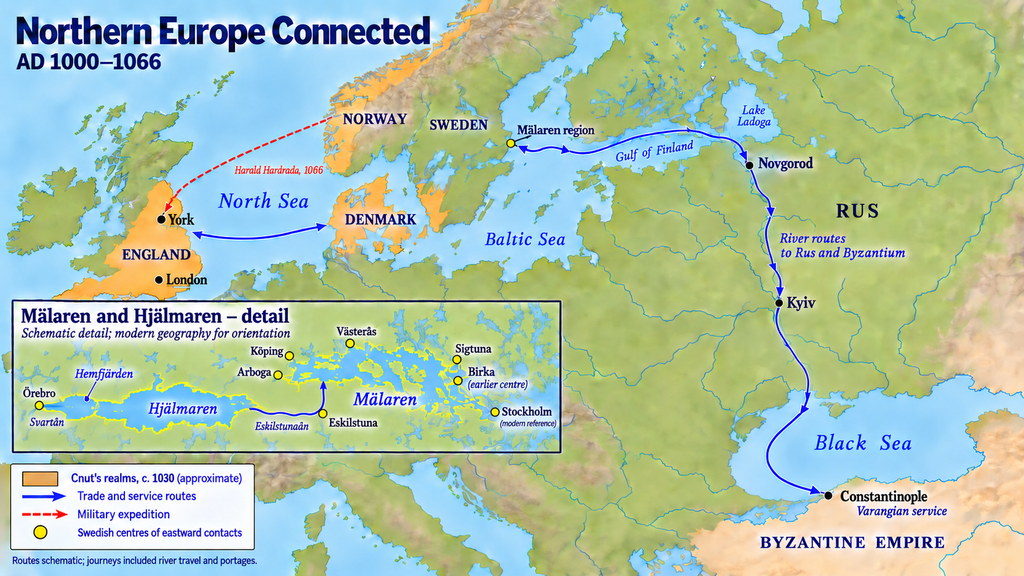
Kyiv, in today’s Ukraine, was a major dynastic and religious centre. Yaroslav the Wise ruled there from 1019 to 1054 and married Ingegerd, daughter of Sweden’s King Olof Skötkonung. Their daughter Anna married Henry I of France in 1051. Family alliances therefore connected Kyiv with Scandinavia, France, Norway and Hungary. [5]
Constantinople, today’s Istanbul in Turkey, belonged to the Byzantine Empire during the Viking period. Scandinavians called it Miklagård, the great city. Northern soldiers served in the imperial Varangian Guard, exchanging military service for pay, status and access to imperial resources.
Harald Hardrada makes the connection concrete. He spent time at Yaroslav’s court and then served Byzantium, including campaigns in Sicily and Bulgaria, before returning to Norway in 1045. The same ruler later attacked England in 1066. Britain, Scandinavia, Kyiv and Constantinople were parts of an interconnected political world. These journeys were contacts with Rus and Byzantium, not campaigns against modern Ukraine or Turkey. [3, 4]
Technology turns land and water into economic power
Population growth and technical change worked together. Heavy ploughs were useful on some northern soils; improved horse harnesses helped cultivation and transport; and three-field rotations spread in parts of western and central Europe. In a simple three-field arrangement, two-thirds of the arable area could be planted each year, compared with one-half in a two-field system. That comparison describes land use, not an automatic one-third increase in crop output: soil, weather and crops still determined results.
Watermills reduced the labour needed to grind grain and later powered textile fulling, hammers and bellows. Historic England estimates that about 6,000 mills existed in England by the time of Domesday in 1086. Machinery was already a substantial economic presence, centuries before steam power. [6]
Mills also changed the distribution of income. Lords could charge for milling; towns and manufacturers benefited from greater processing capacity. Technology therefore increased production while sometimes strengthening the owners of infrastructure.
The changes were regional and gradual. Mediterranean farming did not need exactly the same equipment as heavy northern soils. Europe gained productive capacity through adapting techniques to local conditions, often using knowledge transmitted across political and religious boundaries.
Towns and merchant networks reshape the map
Between approximately 1050 and 1300, growing markets supported larger urban economies. Venice and Genoa linked Europe with Byzantine and Islamic ports. Bruges, Ghent and Ypres concentrated textile production and exchange. River crossings, ports, mining districts and market privileges determined which towns grew.
Some large Italian cities approached roughly 100,000 inhabitants before the Black Death, although individual estimates vary. Most European towns were far smaller. Concentrating that many people required dependable supplies of food, fuel and raw materials, making urban growth inseparable from transport and surrounding agriculture. [7]
In the north, the Hanseatic network developed from merchant cooperation into an association of towns. At its broadest medieval reach it involved more than 200 towns, with four principal overseas trading offices in Novgorod, Bruges, London and Bergen. This was an evolving network, not 200 equally active members of a modern federation at one fixed date. [8]
Trade carried bulk goods as well as luxuries: grain, timber, salt, fish, wool, cloth and metals. Merchant partnerships, credit and bills of exchange helped organise transactions over long distances. Italian banking and northern shipping linked regions with different resources and specialisations.
No single city replaced every earlier centre. Instead, Europe developed several connected concentrations of economic power. The Mediterranean, North Sea and Baltic remained important together, with routes across France, the German lands and the Alps linking them.
Kings and cities build different systems of power
Western and Central Europe also contained competing forms of government. Landlords, bishops and monasteries held extensive rights; peasants owed different combinations of rent, labour and taxes. The term feudalism is useful shorthand, but it should not suggest one uniform European system.
In England, Magna Carta in 1215 constrained royal authority. Parliament developed through later conflict and negotiation. The assembly of 1295 included nobles and bishops alongside two representatives from each county and town summoned. Taxation helped create pressure for consultation, although representation remained far from democratic. [26]
France developed stronger royal administration and more regular military finance. In 1439, the crown obtained authority to levy an annual taille to support an army. War could devastate local economies while strengthening the institutions collecting revenue from them. [27]
The Holy Roman Empire followed a more decentralised path. The Golden Bull of 1356 formalised the position of seven princely electors. Italian cities offered another model, ranging from Venice’s oligarchic republic to cities increasingly controlled by ruling families. Political fragmentation could therefore coexist with sophisticated government and substantial commercial wealth. [28]
Eastern Europe develops competing ways to rule
Eastern Europe had several political systems, not one uniform model. In Rus, princes of the ruling dynasty competed for territories, tribute and seniority. Boyars, church institutions and urban communities also exercised influence. Yaroslav’s death in 1054 was followed by dynastic divisions that weakened Kyiv’s ability to hold the wider political network together. [5]
Novgorod developed institutions involving an urban assembly and powerful elite families. Its northern commercial position supported links with the Baltic. In the southwest, Galicia-Volhynia became an important political centre. Farther west, Poland, Bohemia and Hungary combined monarchy with noble and ecclesiastical privileges.
Revenue usually depended on agricultural communities, customs, tribute and rights over land. In Rus, taxable units included households and farming families; payments could be made in money or goods such as honey, furs and livestock. Later Mongol rulers introduced census-based tribute demands, while Lithuanian authorities governed through princes, officials and existing regional institutions. [9]
After the Mongol conquests, the political centre of gravity shifted unevenly. Kyiv retained religious and commercial importance but lost much of its earlier political primacy. Lithuania expanded over extensive former Rus territories, including Kyiv in 1362–63, while Moscow increasingly consolidated northeastern principalities. [10]
Poland and Lithuania established a dynastic connection in 1386, although they remained distinct political entities. Moscow annexed Novgorod in 1478; the confrontation on the Ugra in 1480 conventionally marks the end of its subordination to the Great Horde. Trade-rich urban autonomy and increasingly centralised princely rule could therefore develop in the same region, with very different outcomes. [11]
The Mongol invasions change the eastern balance
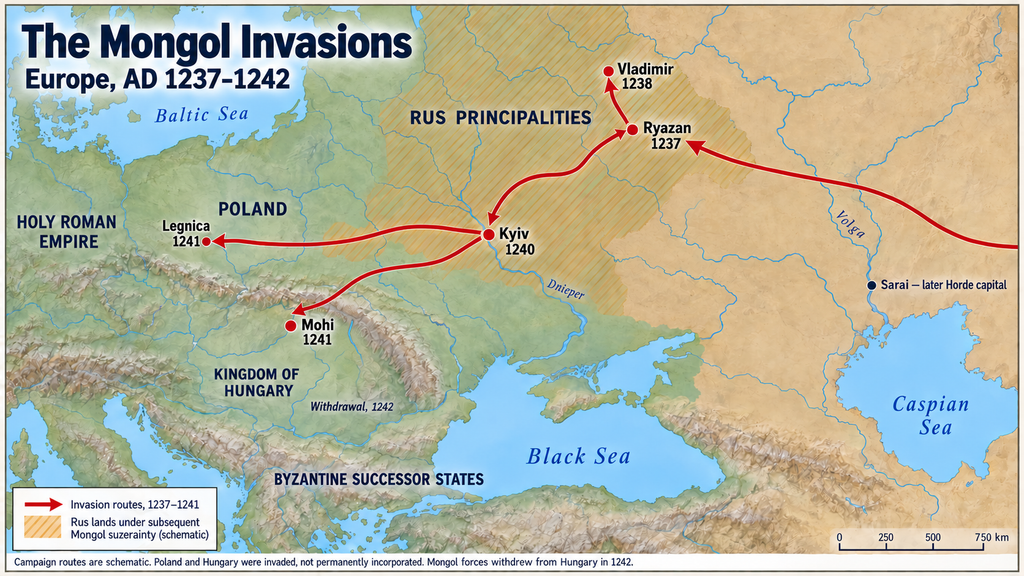
Mongol expansion reached Rus before its best-known attacks on Central Europe. A Rus and Cuman coalition was defeated at the Kalka River in 1223. A much larger invasion followed in 1237–1240, destroying or capturing numerous centres. Kyiv fell in December 1240. [10, 12]
In April 1241, Mongol forces defeated armies at Legnica in Poland and Mohi in Hungary. Their success depended on coordinated mobile forces, mounted archery, intelligence, deception and siege expertise. The ability to capture fortified settlements was as important as winning open battles. [12, 13]
The destruction disrupted farming, settlement and government. Exact casualty totals and percentages are uncertain, and sweeping figures for the whole of Hungary or Rus can imply a precision the evidence does not support. What is clear is the contrast in political outcomes: the Mongols withdrew from Hungary in 1242, while many Rus principalities remained subordinate to the Golden Horde for generations.
There is no settled single explanation for the withdrawal. Imperial succession, strategic choices, resistance, supplies and environmental conditions have all been discussed. A proposed explanation involving wet conditions and cavalry mobility remains disputed in published research. [13]
The Golden Horde ruled from the lower Volga, with Sarai as its capital. It commonly governed Rus through local princes, requiring tribute and recognition of the khan’s authority rather than replacing every local institution. Census-taking, tax collection and patronage helped sustain control. [9, 12]
Conquest also reoriented connections. Steppe and Black Sea networks linked merchants across Eurasia, while princes competed for favour within the Horde’s system. Moscow’s later rise grew partly within these arrangements; it was neither immediate nor inevitable.
Northern kingdoms enter the Baltic economy
After the Viking Age, Scandinavian rulers increasingly concentrated on territorial government and trade. Denmark controlled access between the North Sea and Baltic. Norwegian exports included dried fish; Sweden supplied metals and forest products. Bergen, Stockholm and other ports connected northern resources to merchants operating through Lübeck and the wider Hanseatic network.
Expansion around the Baltic involved settlement and commerce but also warfare and forced Christianisation. German-speaking settlers and craftsmen moved into Central and Eastern Europe, often alongside existing populations. The Teutonic Order established territorial power along the southeastern Baltic, while Lithuania remained a major rival.
The Kalmar Union formally connected Denmark, Norway and Sweden under one monarch in 1397. Its three kingdoms retained their own laws and institutions. Union offered a way to coordinate power, including in dealings with the Hanseatic towns, but conflicts over taxation and royal authority repeatedly weakened it. [14]
Norway’s demographic losses after plague reduced the resources available to its monarchy and elites; union politics cannot, however, be explained by population alone. Dynastic inheritance, trade and aristocratic bargaining also mattered. Northern Europe remained connected to British and continental markets even as its overseas raiding era receded.
Religion and warfare redraw the Mediterranean
Religion linked distant communities through churches, monasteries, pilgrimage and education. It also shaped political boundaries. The rupture conventionally dated to 1054 became a lasting division between Latin and Orthodox Christianity, although separation developed over centuries rather than on one day.
Crusading began with Urban II’s appeal in 1095. Jerusalem was captured in 1099, and Acre, the principal remaining mainland crusader stronghold, fell in 1291. Nearly two centuries of conflict created settlements and commercial opportunities while also producing massacres, displacement and destruction. [15]
The sack of Constantinople by the Fourth Crusade in 1204 was a particularly damaging internal Christian war. Byzantine rule returned in 1261, after 57 years of Latin rule in the capital, but the wider imperial political structure had fragmented. Regional centres such as Nicaea and Trebizond gained importance during that fragmentation. [16]
Ottoman expansion later established a new imperial order in the Balkans and Anatolia. The capture of Constantinople in 1453 ended the Byzantine state centred on that city; remaining Byzantine successor territories were conquered subsequently. The city continued under Ottoman rule and was rebuilt as an imperial capital. Its role changed rather than disappearing. [17]
The Ottoman government drew revenue and military resources from substantial European territories. Imperial taxation, land revenues and urban commerce connected the Balkans with Anatolia and the Mediterranean. Jewish, Muslim and Christian communities remained part of these economies, under unequal and changing conditions. Elsewhere, persecution and expulsions destroyed communities and redirected migration and commercial connections.
Plague and war reverse population growth
Expansion reached its limits unevenly. Poor harvests and the Great Famine of 1315–1317 struck northern Europe before plague reached Mediterranean ports in 1347 and spread across the continent. Estimates commonly place deaths from the first Black Death wave at roughly one-third to one-half of Europe’s population, with major regional differences and continuing scholarly disagreement. [18]
England offers a more closely studied trajectory. One reconstruction estimates 1.71 million people in 1086, 4.81 million in 1348, 2.60 million in 1351 and 1.90 million in 1450. That implies approximately 46% decline between 1348 and 1351 and about 60% by 1450. The longer fall includes repeated epidemics and other demographic pressures, not just the first outbreak. [19]
Losses changed the relationship between land and labour. Some survivors gained better bargaining power, higher real wages or access to property. Employers and landlords attempted to restrict those gains. In parts of western Europe, labour services weakened over time; eastern trajectories differed, and the later intensification of serfdom should not be projected uniformly back onto 1400.
War added another pressure. The Hundred Years’ War, conventionally dated 1337–1453, lasted 116 years with long interruptions. Raids, siege warfare and requisitioning damaged particular French regions far more severely than areas away from active campaigns. Conflict redirected resources towards fortifications, armies and taxation.
A smaller population did not automatically mean that every city lost commercial importance. Some ports retained routes and institutions, drew migrants and recovered before their surrounding regions. Medieval population rankings are consequently an imperfect measure of economic power.
Knowledge and language create wider networks
Universities, translation and more extensive writing helped rulers, merchants and religious institutions organise increasingly complex societies. Bologna’s conventional foundation date is 1088, although its teaching community emerged gradually. Paris and Oxford developed into major centres during the following centuries. [20]
Knowledge travelled through Byzantine, Islamic and Jewish intellectual networks as well as within Latin Christianity. Translations in Iberia and Sicily brought works on philosophy, mathematics and medicine into wider circulation. Europe adapted and extended knowledge accumulated in several civilisations.
Written administration also mattered. England’s Domesday survey of 1086 recorded about 13,000 settlements and 270,000 named or enumerated people, overwhelmingly in a property and taxation context. Those figures describe the record, not England’s entire population: Domesday was not a modern census. The survey shows how documentation could turn landed resources into governing capacity. [21]
Latin remained the principal shared learned language in western Europe; Greek and Church Slavonic supported different eastern networks. Vernacular writing expanded alongside them. The Norman conquest of 1066 intensified contact between English, French and Latin, while Dante’s early-fourteenth-century writing helped demonstrate the literary potential of the Italian vernacular.
Languages still crossed political borders. Multilingual courts, towns and frontier regions were normal. The growth of written languages supported regional identities without producing a continent of neatly bounded national cultures.
New machines change production and information
Medieval technological development went beyond ploughs. Spectacles appeared in Italy in the late thirteenth century, helping some readers and skilled workers continue using their eyesight. Mechanical clocks emerged around the same period and made increasingly regular public timekeeping possible. Surviving mechanisms at Salisbury and Wells are dated to about 1386 and 1390. [22]
Ships, navigation and metalworking supported wider exchange. Northern cargo vessels and Mediterranean shipping served different seas and goods. Improved instruments and accumulated practical knowledge helped mariners attempt longer routes; navigation remained difficult and risky.
Gunpowder weapons, using a technology originating in China, became increasingly important in Europe during the fourteenth and fifteenth centuries. Artillery changed siege warfare and increased the advantage of rulers able to finance equipment and specialist crews. Knights did not suddenly disappear, but warfare became more dependent on expensive organisation and supplies.
Printing greatly expanded the ability to reproduce information. Gutenberg’s Bible was produced in Mainz around 1454–1455 in approximately 180 copies. Printing with movable metal type had earlier precedents in East Asia; Gutenberg’s achievement was the development of an effective European production system. [23]
The surviving fifteenth-century printing record contains roughly 30,000 editions. An edition is a publishing issue, not one physical book, so this figure indicates many more individual copies. Lower reproduction costs and more consistent texts supported teaching, administration and scholarship, although literacy and access remained unequal. [24]
Italian Renaissance culture developed within this commercial and institutional environment. Wealthy patrons funded artists and humanist scholarship; Greek scholars and manuscripts also moved west through contacts with Byzantium. The Renaissance built on medieval learning rather than beginning after five centuries of intellectual inactivity.
By 1500 the Atlantic adds a new direction
Iberia’s political transformation connected conquest at home with expansion overseas. The marriage of Isabella and Ferdinand in 1469 linked Castile and Aragon dynastically, while their institutions remained distinct. Granada surrendered in 1492, ending Muslim sovereign rule in Iberia. The same year, the monarchy ordered Jews to convert or leave, disrupting long-established communities.
Columbus’s Atlantic crossing in 1492 and Vasco da Gama’s arrival in India in 1498 opened routes with consequences far beyond Europe. Mariners combined suitable ships, finance and sailing knowledge with instruments such as the mariner’s astrolabe, in use from about 1470. [25]
These voyages did not immediately replace Mediterranean or Baltic trade. They added an expanding Atlantic direction to an already interconnected economy. Overseas conquest would also bring exploitation, enslavement and catastrophic disruption for populations outside Europe.
| Region | Changing centres | Main drivers |
| North Sea and Baltic | Scandinavian kingdoms, Lübeck, Bergen, Stockholm | Royal consolidation, fish and metals, Hanseatic commerce |
| Western Europe | London, Paris, Flemish towns | Textiles, taxation, population losses, dynastic warfare |
| Central Europe | Imperial towns, Prague, mining districts | Regional autonomy, urban law, metals and inland trade |
| Mediterranean | Venice, Genoa, Florence | Shipping, finance, manufacturing and Renaissance patronage |
| Eastern Europe | Kyiv, Novgorod, Vilnius, Moscow | Mongol tribute, Lithuanian expansion and Muscovite consolidation |
| Southeastern Europe | Constantinople, Balkan centres | Byzantine fragmentation and Ottoman imperial expansion |
| Atlantic Iberia | Lisbon, Castilian ports | Dynastic consolidation, navigation and overseas routes |
The pattern is a redistribution of influence, not a simple march from east to west. Kyiv lost political primacy without disappearing. Constantinople changed imperial rulers. Northern trading towns grew alongside Italian centres. Moscow and Lithuania expanded through different governing arrangements, while Atlantic ports gained opportunities whose full impact lay after 1500.
Five centuries of population growth, technical adaptation and commercial exchange had enlarged Europe’s economic possibilities. Invasion, plague and war then reshaped who could exploit them. By 1500, the continent remained divided, but its rulers, towns and societies operated within much denser networks of trade, administration and knowledge.
Sources and data notes
Population tables use one reconstruction consistently; other studies give different totals. The separate English series uses a different study and geography. Derived percentages are calculated from the cited values. Medieval fleet figures are reported chronicle estimates. Dates measure chronology and do not substitute for production or population counts where those are available.
[1] Paolo Malanima. Energy and Population in Europe The Medieval Growth (2010), Tables 1–2. Author manuscript reproduced online.
https://studylib.net/doc/11913101/energy-and-population-in-europe-the-medieval-growth–10
[2] Viking Ship Museum, Roskilde. Cnut the Great.
[3] English Heritage. Fulford and Stamford Bridge The Northern Battles of 1066.
[4] National Museum of Denmark. Dangerous journeys to Eastern Europe and Russia.
[5] Internet Encyclopedia of Ukraine. Yaroslav the Wise and Anna Yaroslavna.
https://www.encyclopediaofukraine.com/display.asp?linkpath=pages%5CA%5CN%5CAnnaYaroslavna.htm
https://www.encyclopediaofukraine.com/display.asp?linkpath=pages%5CY%5CA%5CYaroslavtheWise
[6] Historic England. The Forge Mill, listing 1005270, historical background on medieval mills.
https://historicengland.org.uk/listing/the-list/list-entry/1005270
[7] Harry A. Miskimin, Cambridge University Press. The Economy of Early Renaissance Europe 1300–1460, Town and Industry.
[8] THE HANSA. The Hansa in a nutshell.
https://www.hanse.org/en/discover-the-hanseatic-cities/the-hansa-in-a-nutshell
[9] Internet Encyclopedia of Ukraine. Tribute.
https://www.encyclopediaofukraine.com/display.asp?linkpath=pages%5CT%5CR%5CTribute.htm
[10] Internet Encyclopedia of Ukraine. Kyiv, decline and revival in the thirteenth to sixteenth centuries.
https://www.encyclopediaofukraine.com/pages%5CK%5CY%5CKyiv.htm
[11] Janet Martin, Cambridge University Press. Medieval Russia 980–1584, second edition, chronology.
https://api.pageplace.de/preview/DT0400.9780511368004_A24403778/preview-9780511368004_A24403778.pdf
[12] Internet Encyclopedia of Ukraine. Tatars and Golden Horde.
https://www.encyclopediaofukraine.com/pages%5CT%5CA%5CTatars.htm
[13] Büntgen and Di Cosmo; Pinke and colleagues. Scientific Reports (2016 and 2017), contrasting explanations of the Mongol withdrawal from Hungary.
https://doi.org/10.1038/srep25606
Counterargument: https://www.nature.com/articles/s41598-017-12128-6
[14] Store norske leksikon. Kalmarunionen.
[15] The Metropolitan Museum of Art. The Crusades 1095–1291.
https://www.metmuseum.org/de/essays/the-crusades-1095-1291
[16] The Metropolitan Museum of Art. Byzantium ca 330–1453.
https://www.metmuseum.org/de/essays/byzantium-ca-330-1453
[17] The Metropolitan Museum of Art. The Art of the Ottomans before 1600.
https://www.metmuseum.org/essays/the-art-of-the-ottomans-before-1600
[18] Ohio State University, Origins. The Black Death and its Aftermath.
https://origins.osu.edu/connecting-history/covid-black-death-plague-lessons
[19] Oxford Academic, Significance. Measuring the Middle Ages (2022), reporting Broadberry et al. (2015).
https://academic.oup.com/jrssig/article/19/4/16/7029516
[20] University of Bologna. Nine centuries of history.
[21] The National Archives. Domesday and Domesday Book research guide.
https://www.nationalarchives.gov.uk/explore-the-collection/explore-by-time-period/medieval/domesday
[22] Science Museum and English Heritage. Historical clocks and Medieval Inventions.
https://blog.sciencemuseum.org.uk/step-back-time-two-historical-clocks-re-displayed
Spectacles: https://www.english-heritage.org.uk/visit/inspire-me/ingenious/medieval-ingenuity/
[23] Library of Congress. The Gutenberg Bible.
https://loc.gov/exhibits/bibles/interactives/gutenberg/index.html
[24] Consortium of European Research Libraries. British Library Incunabula Short Title Catalogue coverage.
https://incunabula.cerl.org/resources/hpb/content/british_library_london
[25] Royal Museums Greenwich. What is a mariner’s astrolabe.
https://www.rmg.co.uk/stories/space-astronomy/what-mariners-astrolabe
[26] UK Parliament. Magna Carta to Henry IV, parliamentary chronology.
[27] William J. Bouwsma, University of California Press. A Usable Past, discussion of French taxation and the assembly of 1439.
[28] Fordham University, Medieval Sourcebook. The Golden Bull of Charles IV 1356, translated primary document.
https://sourcebooks.web.fordham.edu/source/goldenbull.asp
Leave a Reply