
From rival armies and a divided continent to an increasingly united defence and military network
Europe has built some of the world’s strongest economies and most advanced military industries. Its central defence challenge is to turn that combined strength into forces that can act together, defend European territory and sustain a wider role in the world.
For centuries, European states directed much of their military power against one another. Today, cooperation connects former rivals through alliances, multinational formations and industrial networks. Russia’s war against Ukraine has made the gap between Europe’s resources and its collective readiness harder to ignore.
From internal rivalry to a divided continent
Before the world wars, European states competed for territory, trade, colonies and influence. Military strength usually served national ambitions rather than a common European interest. External attacks, including the Mongol invasions and Ottoman expansion, also encouraged defensive alliances, but did not produce lasting continental unity.
Viewed at continental scale, this article describes the conflicts between European states as European civil wars. This is an interpretive framing, rather than the conventional definition of civil war within one state. Russia is considered separately in the present security comparison, while modern Türkiye must be distinguished from the Ottoman Empire and recognised as a NATO ally.
The First World War began in 1914 through a European crisis and competing alliances, then drew in external powers and colonial societies. The armistice in November 1918 ended fighting on the Western Front after Germany’s defeat. The peace settlement failed to establish durable European cooperation. [1]
The Second World War began in Europe with Nazi Germany’s invasion of Poland in 1939. Another conflict within Europe became a world war, involving the Soviet Union, the United States and the connected war in Asia. Nazi conquest, occupation and genocide devastated the continent. By 1945, European countries had lost much of their ability to determine the global order alone.
The Cold War divided Central and Eastern Europe under Soviet domination from a Western Europe increasingly protected by the United States. NATO, founded in 1949, became the main collective-defence framework for its Western European members. The Soviet-led Warsaw Pact followed in 1955. American influence rested on an alliance of sovereign states; Soviet control included coercion and military intervention. [2,3]
Integration across the former dividing line
European integration began before 1989. The European Coal and Steel Community and the European Economic Community connected Western European economies during the Cold War. The fall of the Berlin Wall in 1989, German reunification in 1990 and the dissolution of the Warsaw Pact and Soviet Union in 1991 allowed integration to extend across the former divide. [4,2]
Central and Eastern European countries chose closer relationships with the EU and NATO. Enlargement brought more of Europe’s population, infrastructure and industrial capacity into shared institutions. The period after 1989–1991 is therefore decisive for broader European integration, even though it did not create a single European army. [5]
Many governments initially reduced their forces after the Cold War. Russia’s attacks on Ukraine reversed the expectation that major territorial war had largely disappeared from Europe. Defence now requires rebuilding readiness while connecting national capabilities more closely.
This gives Europe the possibility of greater independence. Integration has reduced Russia’s influence over countries once held within the Soviet sphere. More European capability can also reduce dependence on American decisions and resources. That change can strengthen NATO while giving Europe more freedom to act.
The scale of European military resources
Europe, the EU and NATO overlap, but serve different purposes. Britain and Norway are central to European defence outside the EU. NATO connects European members with the United States, Canada and Türkiye. Ukraine’s defence is central to European security without NATO membership.
NATO provides collective military planning and defence. The EU contributes economic instruments, financing and industrial coordination. National governments retain control over their forces and most deployment decisions.
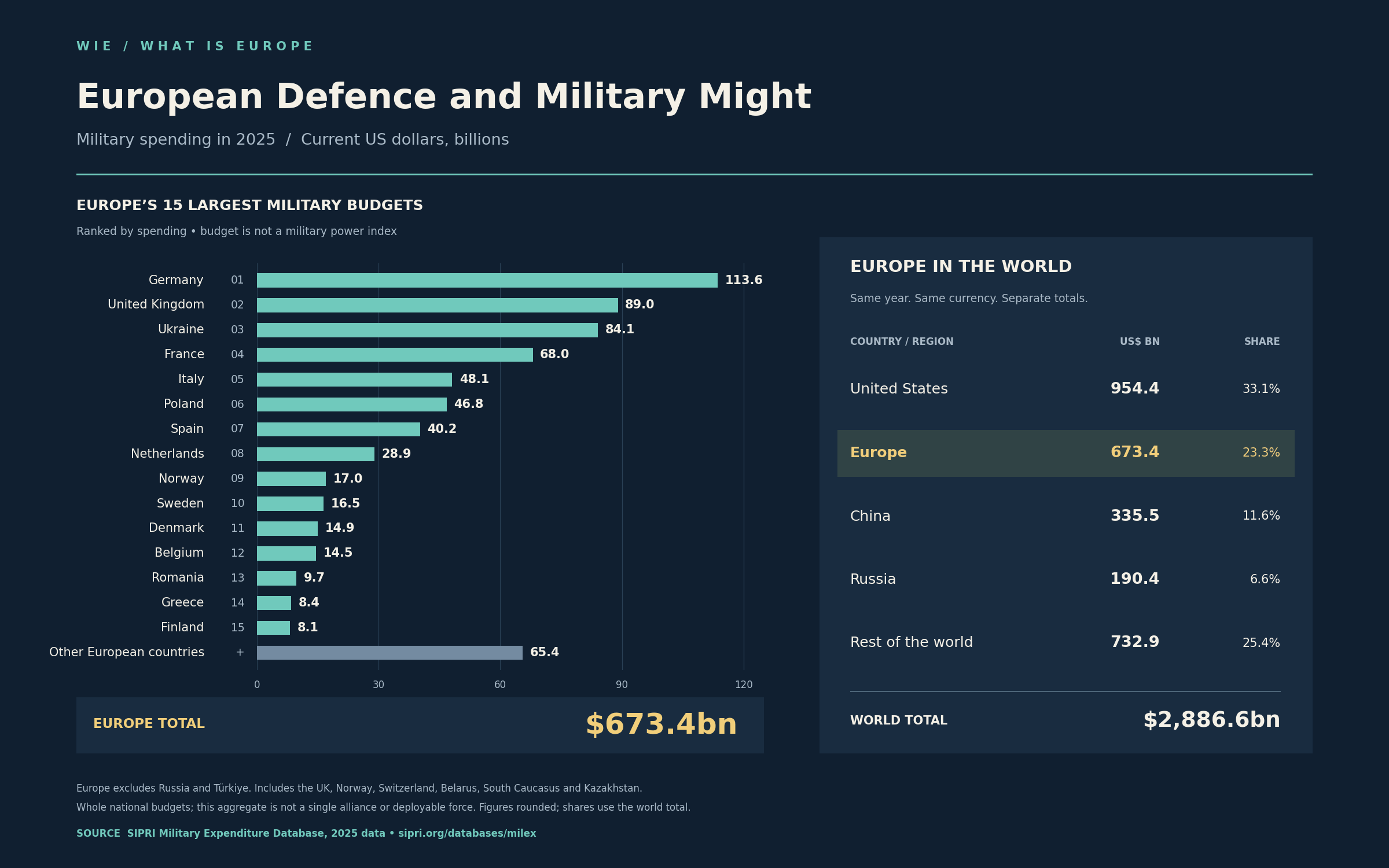
| Military expenditure 2025 | USD billion |
| United States | 954.4 |
| Europe excluding Russia and Türkiye | 673.4 |
| China | 335.5 |
| Russia | 190.4 |
| Rest of the world | 732.9 |
| World total | 2,886.6 |
Source: SIPRI, current US dollars, 2025. The European total follows the broad country scope used here, including Cyprus, the South Caucasus and Kazakhstan, while excluding Russia and Türkiye. Entire national budgets are counted. Türkiye is included in the rest of the world. This is an aggregate of national expenditure, not an EU or NATO budget. [6]
Europe’s resources are substantial, but expenditure alone does not measure military effectiveness. Costs, equipment, training, intelligence and the ability to sustain operations all matter. [7]
National forces also contribute different strengths. Britain and France combine conventional forces with nuclear deterrence. Poland and the Baltic states focus heavily on eastern-flank defence. Finland’s reserve-based model and Nordic maritime and air capabilities add further depth. Mediterranean countries contribute important land, naval and air forces.
The post-Cold War reduction in personnel changed the force structure, but headcounts alone cannot explain the result. A reserve becomes usable military capacity only when people have assigned units, training, equipment and logistics. Adding every reported reservist to active personnel would overstate the force available for immediate deployment.
Europe’s leading military countries
The following 15 countries are ordered by their position in Global Firepower’s 2026 conventional-capability ranking, using this article’s European scope. It is a comparative index, not an official NATO assessment or a prediction of battlefield results. Russia and Türkiye remain outside the European aggregate. [50]
| # | Country | World rank | Spend 2025 USD bn | Active personnel | Reported reserves |
| 1 | France | 6 | 68.01 | 264,000 | 43,444 |
| 2 | United Kingdom | 8 | 88.98 | 141,330 | 31,940 |
| 3 | Italy | 10 | 48.14 | 165,500 | 18,300 |
| 4 | Germany | 12 | 113.59 | 184,324 | 860,000 |
| 5 | Spain | 18 | 40.21 | 121,802 | 24,033 |
| 6 | Ukraine | 20 | 84.11 | 900,000 | 4,000,000 |
| 7 | Poland | 21 | 46.76 | 250,000 | 350,000 |
| 8 | Sweden | 26 | 16.47 | 25,600 | 34,000 |
| 9 | Greece | 30 | 8.39 | 142,700 | 221,350 |
| 10 | Netherlands | 34 | 28.94 | 44,245 | 8,510 |
| 11 | Portugal | 38 | 5.86 | 25,000 | 23,500 |
| 12 | Norway | 39 | 17.03 | 33,440 | 20,100 |
| 13 | Denmark | 45 | 14.95 | 21,000 | 12,000 |
| 14 | Switzerland | 46 | 7.59 | — | — |
| 15 | Finland | 48 | 8.08 | 24,000 | 870,000 |
| — | Other European countries | — | 76.25 | 823,768 | 1,933,820 |
| — | EUROPE TOTAL | — | 673.37 | 3,166,709 | 8,450,997 |
Sources: SIPRI military expenditure 2025 and GFP personnel and ranking 2026. Personnel cover all armed services. Swiss militia formation membership of 146,718 in 2025 is reported separately and excluded from the active total. Missing entries are not treated as evidence of zero capacity. The total includes Belarus, the South Caucasus and Kazakhstan; it is not an allied deployable force. [6,50–53]
Reported reserves are not a mobilisation timetable. Equipment, recent training and unit assignments determine how much of the pool can be fielded. The Swiss militia illustrates why national personnel categories cannot always be added on the same basis.
Russia and the threats beyond the battlefield
Russia’s full-scale invasion of Ukraine is Europe’s immediate territorial security challenge. Ukraine is defending its sovereignty, while Europe faces the wider question of whether force can redraw borders and determine smaller states’ political choices.
Georgia and Moldova belong in this discussion, although their circumstances differ. Russian troops remain in both countries without their governments’ consent. [8]
Russia’s war also connects Europe to other regions. NATO has identified North Korean troops, Iranian weapons and Chinese support for Russian military production. These contributions differ: combat personnel, weapons, components, trade and diplomatic backing should not be treated as interchangeable. [9]
Russia’s regional security relationships are less cohesive than a simple alliance map suggests. Armenia’s frozen participation in the Collective Security Treaty Organization illustrates this. Nor does the Global South form one Russian-aligned bloc: its countries pursue different commercial, diplomatic and security interests. [10,11]
The pressure extends beyond conventional warfare. Cyberattacks, sabotage, information manipulation and political interference can disrupt Europe’s ability to support Ukraine and defend itself. The shadow fleet adds maritime risks and sanctions-enforcement challenges. Industrial sites, ports, energy supplies and communications belong within the same resilience planning. [12,13]
Russian influence through political networks, business relationships and religious leadership requires evidence about specific actors and conduct. The European Parliament has documented interference involving parts of the far right and far left; sanctions against Patriarch Kirill concern his support for the war. Russian language, Orthodox faith or an older generation’s memories of the Soviet era do not establish political loyalty. [14,15]
How Europe built its arms industry
Europe’s arms industry grew from national arsenals, shipyards and engineering firms supplying competing states. Industrialisation linked military power to steel, engines, chemicals and large-scale manufacturing. The world wars expanded production, while the Cold War sustained national capabilities within rival alliance systems.
Cooperation also developed during the Cold War. The Franco-German Transall and multinational Tornado programmes shared costs and expertise. Later consolidation created larger groups: EADS, now Airbus, in 2000; MBDA in 2001; and KNDS in 2015. These companies connected national capabilities without eliminating competition or independent manufacturers. [16,17,18,19]
Today’s industry is already connected through shared ownership, joint programmes, suppliers and maintenance networks. The industry map makes this visible through 45 selected hubs in 18 countries, with Ukraine shown as a national network. Its numbers identify places, not rankings, and each colour highlights one representative capability.
Aircraft capability has several centres. BAE Systems in Lancashire (map 3), Dassault in Mérignac (11), Airbus in Manching (20) and Saab in Linköping (31) illustrate Europe’s range of combat-aircraft producers. Rolls-Royce in Bristol (5) and Safran at Villaroche (9) add military engine expertise. Airbus also assembles transport aircraft in Seville (15). [20–22,61–65,82–83]
The naval network extends from British submarine construction at Barrow (2) to Naval Group in Cherbourg and Lorient (7–8), TKMS in Kiel (17), Fincantieri in Liguria (29) and Saab Kockums in Karlskrona (32). These locations cover different roles in submarine and surface-warship design, construction and support. [23–24,66–68]
Weapons and land systems form another broad network. MBDA’s Bourges sites (10), Rheinmetall in Unterlüß (18), KNDS in Kassel (19), Kongsberg (35) and Nammo in Raufoss (36) show the importance of missiles, ammunition, artillery and manufacturing. Patria’s vehicle plants in Finland and Latvia (37 and 39) provide a concrete example of production across borders. [25–26,69–74]
Electronics and autonomy connect these platforms. Saab in Gothenburg (30) and Thales in Hengelo (23) develop and produce radar systems. The Munich region (21), Milrem in Tallinn (38) and WB Group’s Flytronic in Gliwice (40) illustrate the growing drone, robotics and software sector. Ukraine’s industry and international partnerships connect production with wartime experience. [27–28,75–79]
The map shows an industrial network rather than a single production system. Companies often work in several categories, and regional markers can include development, assembly or support at different sites. Existing factories and announced expansions must also be distinguished: more investment does not immediately mean more delivered equipment. [69–79]
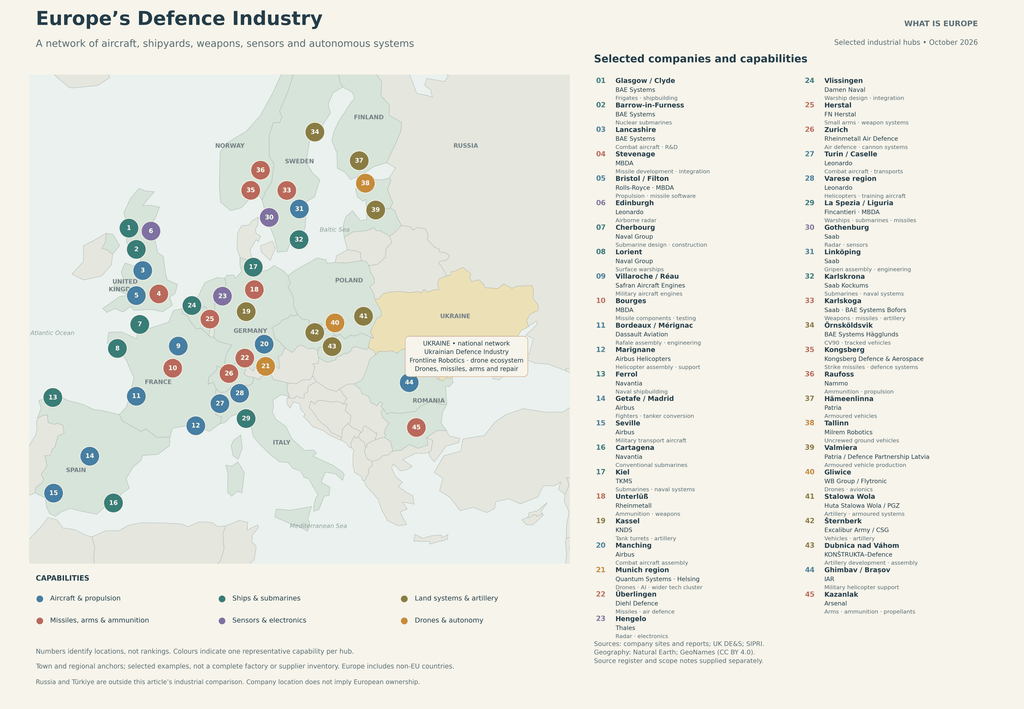
Europe’s defence industry. Selected industrial hubs and representative companies, including countries outside the EU. Numbers match the locations discussed above. Regional markers do not imply that all production takes place at one site. Sources checked in October 2026; geography from Natural Earth and GeoNames. [61–83]
Europe compared with other arms industries
| Industry group | Companies in Top 100 | 2024 arms revenues USD bn | Real change from 2023 |
| United States | 39 | 334.0 | +3.8% |
| Europe excluding Russia and Türkiye | 26 | 151.0 | +13% |
| China | 8 | 88.3 | −10% |
| Russia | 2 reported groups | 31.2 | +23% |
| Other countries and regions | 25 | 74.5 approximately | Not calculated |
| Top 100 total | 100 | 679.0 | +5.9% |
Source: SIPRI Top 100, 2024. Figures measure arms and military-services revenues of the listed companies, not defence budgets, exports or weapons produced. Companies are grouped by headquarters, including overseas subsidiaries. Europe excludes Russia and Türkiye. Russian coverage is especially incomplete; the two reported groups do not represent its entire industry. The remaining total is a rounded residual. [29,30]
The United States has the largest reported corporate base, supported by a large domestic market and international sales. Europe combines major groups with cross-border programmes and independent producers. China’s large state-linked companies primarily serve its domestic requirements. Russia’s industry is operating under wartime demand, although limited disclosure makes a full comparison difficult. [29,30]
Europe’s industrial challenge is to retain advanced design capability while producing enough ammunition, drones, air defence and replacement equipment. A sophisticated platform needs spare parts, maintenance and replenishment throughout its service life. Long-term orders and compatible requirements make investment and production at scale easier. [31]
Reported Russian threats against European factories supplying Ukraine underline the strategic importance of this network. Threats are not proof that an attack has been authorised, but industrial protection must cover physical sites, digital systems, energy, suppliers and transport. [32,33]
Connecting national forces
European military integration already exists through multinational headquarters, NATO formations and regional cooperation. Eurocorps can serve NATO and the EU. The Joint Expeditionary Force connects northern European partners, while bilateral agreements and shared procurement create further links. [34,35,36,37,38]
The next step is to make these arrangements more dependable. Common planning, compatible equipment, shared logistics and integrated air defence can allow national units to operate as larger formations. Cooperation can also reduce duplication in procurement, training and maintenance.
Fewer headquarters would be useful only if they improved readiness and command. Governments still need to agree who authorises deployment, pays for sustained operations and replaces losses. Several integrated regional formations may be easier to build than a single European army, but either approach needs political authority that matches its military responsibilities.
Nuclear deterrence remains a separate question of control and credibility. US strategic forces are central to NATO’s deterrence, with British and French forces also contributing. A broader European nuclear role would require explicit decisions about coverage and authority. [39]
Europe and its global relationships
North America remains Europe’s principal alliance relationship through the United States and Canada. Australia and New Zealand are close partners; Japan and South Korea also cooperate with NATO. These partnerships do not make the Indo-Pacific an extension of NATO membership. [40,41]
Africa is a major partner in trade, development and security. Conflict, trafficking, maritime insecurity and displacement can affect Europe, while Russian involvement in parts of Africa adds competition for influence. Cooperation needs to address African priorities as well as European interests. Migration policy and border management must distinguish people seeking protection from armed groups and coercive state action. [42,43]
Latin America and the Caribbean have extensive historical, cultural and commercial links with Europe. European overseas territories also create responsibilities for civilian protection and maritime security. Cooperation is principally with independent partners, whose choices cannot be inferred from their colonial history. [44]
Asia contains partners as well as competitors and threats. Iran’s use of proxies and criminal networks creates security risks inside Europe. China presents a different challenge through espionage, sensitive technology and strategic dependencies, alongside substantial trade. Belt and Road projects need individual scrutiny of control, debt and data access; participation alone is not evidence of hostile activity. [45,46,47]
India and ASEAN countries pursue varied relationships rather than belonging to a single camp. Europe therefore needs to assess actual commitments and conduct. Trade with Russia or China, BRICS membership and a formal defence alliance are different relationships. [48,49]
A global map of security relationships
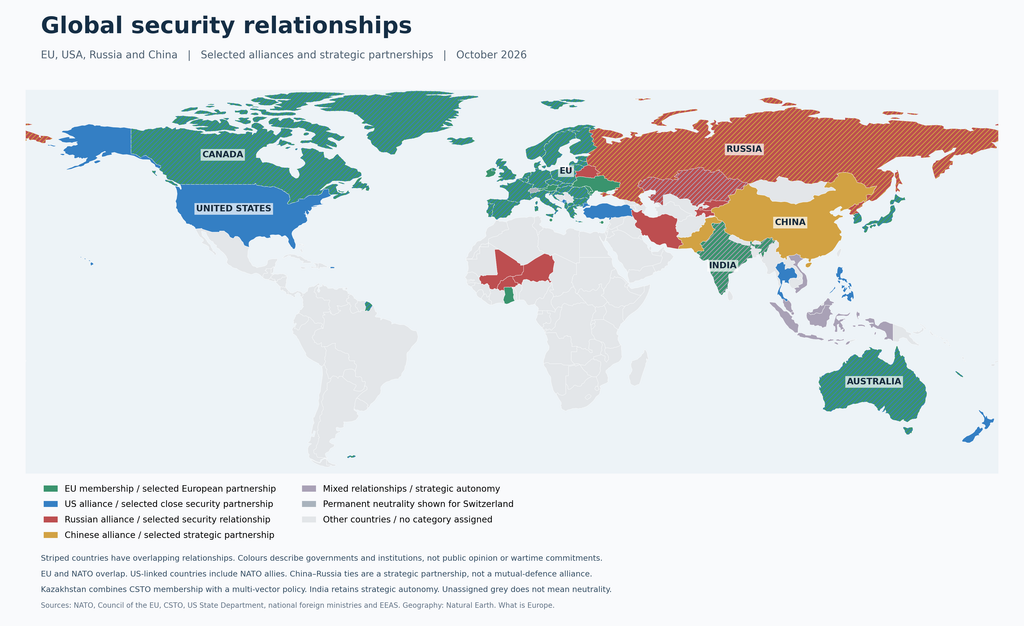
A selected overview of relationships with the EU, USA, Russia and China. Stripes show overlap, while mixed relations and strategic autonomy are distinct from permanent neutrality. Grey countries have not been assigned a category. Overseas territories follow their administering state for orientation. These are institutional and governmental relationships, not predictions that a country would support a particular war. [40–43,48–49,54–60]
The EU and USA share much of their security network. Russia and China cooperate closely without forming a NATO-style alliance. Pakistan’s Chinese partnership, Kazakhstan’s Russian alliance and India’s EU partnership coexist with other relationships. A single exclusive camp would hide these differences.
A European power able to act
A crisis in the Indo-Pacific could increase demands on American forces and attention. Europe needs the capacity to defend its own territory while maintaining partnerships and protecting sea routes, infrastructure and industrial knowledge. This requires priorities that match its resources.
The foundation is already present: strong economies, established armed forces and an extensive defence industry. The political task is to agree when and how to use that strength. Europe’s progress as a military power will be measured by its ability to deploy forces together, sustain them and make decisions when security demands action.
Sources
[1] Imperial War Museums — The armistice and the end of the First World War
https://www.iwm.org.uk/history/first-world-war/armistice
[2] NATO — A short history of NATO
https://www.nato.int/en/about-us/nato-history/a-short-history-of-nato
[3] NATO — Warsaw Pact history
https://www.nato.int/cps/en/natohq/declassified_138294.htm
[4] Council of the EU — How treaties shaped European institutions
[5] Council of the EU — Enlargement history
https://www.consilium.europa.eu/en/topics/eu-enlargement
[6] SIPRI — Military Expenditure Database and 2025 data workbook
https://www.sipri.org/databases/milex
[7] SIPRI — Sources and methods
https://www.sipri.org/databases/milex/sources-and-methods
[8] OSCE — Joint statement on Russian forces in Georgia and Moldova
https://cdn.osce.org/sites/default/files/f/documents/3/9/582397.pdf
[9] NATO — Deputy Secretary General remarks 24 February 2025
https://www.nato.int/cps/en/natohq/opinions_233466.htm?selectedLocale=en
[10] CSTO — Member country list
https://en.odkb-csto.org/countries
[11] Armenpress — Armenian Prime Minister on frozen CSTO participation May 2026
https://armenpress.am/en/article/1247920
[12] Council of the EU — Sanctions against Russian hybrid threats
https://www.consilium.europa.eu/en/policies/sanctions-against-russia-hybrid-threats
[13] European Council — Meeting 18 and 19 June 2026
https://www.consilium.europa.eu/en/meetings/european-council/2026/06/18-19
[14] European Parliament — Resolution on Russian interference 25 April 2024
https://www.europarl.europa.eu/doceo/document/TA-9-2024-0380_EN.html
[15] UK Government — Sanctions including Patriarch Kirill 16 June 2022
https://www.gov.uk/government/news/uk-sanctions-russian-linked-to-forced-transfers-and-adoptions
[16] Airbus — Defence cooperation history
https://www.airbus.com/en/about-us/our-history/our-story
[17] Airbus — Formation of EADS in 2000
[18] MBDA — Company history
https://www.mbda-systems.com/our-company/our-history
[19] KNDS — Group history
https://knds.com/en/about-us/history
[20] Dassault Aviation — Rafale
https://www.dassault-aviation.com/en/defense/rafale
[21] Saab — Air products
https://www.saab.com/products/air
[22] Airbus — Eurofighter
https://www.airbus.com/en/products-services/defence/military-aircraft/eurofighter
[23] Naval Group — Naval capabilities
https://www.naval-group.com/en
[24] Saab — Naval products
https://www.saab.com/products/naval
[25] KNDS — Group and capabilities
[26] MBDA — Our company
https://www.mbda-systems.com/our-company
[27] European Commission — EU Ukraine Drone Alliance
https://defence-industry-space.ec.europa.eu/eu-ukraine-drone-alliance_en
[28] European Commission — Defence SMEs
https://defence-industry-space.ec.europa.eu/eu-defence-industry/defence-smes_en
[29] SIPRI — Top 100 company revenues in 2024
[30] SIPRI — Top 100 fact sheet December 2025
https://www.sipri.org/sites/default/files/2025-11/fs_2512_top_100_2024.pdf
[31] European Commission — European Defence Industrial Strategy 2024
https://eur-lex.europa.eu/legal-content/EN/TXT/?uri=CELEX%3A52024JC0010
[32] Reuters — European drone production and Russian threats 17 April 2026
[33] Kyiv Independent — Russian threats against European arms factories 30 September 2026
https://kyivindependent.com/russia-threatens-european-arms-factories-supplying-ukraine
[34] NATO — Force model
https://nato.int/en/what-we-do/deterrence-and-defence/nato-force-model
[35] NATO — Rapid deployable corps
https://www.nato.int/en/what-we-do/deterrence-and-defence/rapid-deployable-corps
[36] Eurocorps — A force for EU and NATO
[37] NATO — Strengthening the eastern flank
https://nato.int/en/what-we-do/deterrence-and-defence/strengthening-natos-eastern-flank
[38] Swedish Armed Forces — Joint Expeditionary Force
https://www.forsvarsmakten.se/kontakt/press-och-media/undervattenshot-i-fokus-under-marinovning-hos
[39] NATO — Nuclear deterrence policy and forces
https://www.nato.int/en/what-we-do/deterrence-and-defence/natos-nuclear-deterrence-policy-and-forces
[40] NATO — Member countries
https://www.nato.int/en/what-is-nato
[41] NATO — Relations with Indo Pacific partners updated September 2026
[42] Council of the EU — EU Africa relations
https://www.consilium.europa.eu/en/policies/eu-africa
[43] EEAS — Europe as a security partner for Africa
https://www.eeas.europa.eu/eeas/eu-has-been-and-will-remain-reliable-security-partner-africa_en
[44] Council of the EU — EU CELAC summit 9 November 2025
https://www.consilium.europa.eu/en/meetings/international-summit/2025/11/09
[45] Swedish Security Service — Security assessment 2025 2026
https://sakerhetspolisen.se/download/18.6d8b207419df2497fd955/1778075300407/SP_La%CC%88gesbild%20ENG_Anpassad.pdf
[46] EEAS — EU China relations
https://www.eeas.europa.eu/eeas/eu-china-relations_en
[47] EEAS — Europe Asia connectivity and Belt and Road
https://www.eeas.europa.eu/node/61412_en
[48] Indian Ministry of External Affairs — Foreign policy and strategic autonomy
https://www.mea.gov.in/indian-foreign-policy.htm
[49] ASEAN — Outlook on the Indo Pacific
https://asean.org/speechandstatement/asean-outlook-on-the-indo-pacific
[50] Global Firepower — World ranking and European comparison 2026
https://www.globalfirepower.com/countries-listing.php
[51] Global Firepower — Active military personnel 2026
https://www.globalfirepower.com/active-military-manpower.php
[52] Global Firepower — Reported reserves 2026
https://www.globalfirepower.com/active-reserve-military-manpower.php
[53] Swiss Armed Forces — Personnel establishment 2025
https://www.vtg.admin.ch/de/newnsb/xuwUeOIz_xaTbi1NC9840
[54] Council of the EU — Security and defence partnerships
https://www.consilium.europa.eu/en/policies/security-defence-partnerships
[55] US State Department — Indo-Pacific treaty alliances
https://2021-2025.state.gov/fact-sheet-secretary-blinkens-remarks-on-a-free-and-open-indo-pacific
[56] China Ministry of Foreign Affairs — Pakistan partnership May 2026
https://www.fmprc.gov.cn/mfa_eng/xw/zyxw/202605/t20260522_11915994.html
[57] China Ministry of Foreign Affairs — China DPRK treaty July 2026
https://www.fmprc.gov.cn/eng/xw/zyxw/202607/t20260713_11980494.html
[58] China Ministry of Foreign Affairs — Russia relationship and non-alliance March 2026
https://www.fmprc.gov.cn/eng/wjb/wjbz/hd/202603/t20260308_11870441.html
[59] Kazakhstan Ministry of Foreign Affairs — Multi-vector policy
https://www.gov.kz/memleket/entities/mfa-ottawa/press/news/details/740515?lang=en
[60] Swiss Federal Government — Permanent neutrality
https://www.admin.ch/en/switzerlands-policy-of-neutrality
[61] BAE Systems — Warton and Lancashire aerospace programmes
https://www.baesystems.com/en-uk/locations/warton
[62] Dassault Aviation — Mérignac final assembly and engineering
https://www.dassault-aviation.com/en/passion/history/sites/merignac
[63] Airbus — Defence industrial locations in Spain and their roles
[64] Rolls-Royce — Bristol Defence Assembly and Operations April 2026
https://www.rolls-royce.com/media/press-releases/2026/24-04-2026-additive-manufacturing-development-cell-opens-in-bristol.aspx
[65] Safran — Villaroche industrial site and military engine assembly
https://www.safran-group.com/locations/france/villaroche-2077950
[66] BAE Systems — Submarines and Barrow industrial base
https://www.baesystems.com/en-uk/uk-businesses/maritime/submarines
[67] TKMS — Kiel submarine base and Wismar capacity expansion January 2026
[68] Fincantieri — Naval shipbuilding at Riva Trigoso and Muggiano
[69] MBDA — Sustainability Report 2024 pages 16 and 17 industrial locations
https://www.mbda-systems.com/sites/mbda/files/2025-10/mbda_sustainabilityreport24_web_eng_20251015.pdf
[70] Rheinmetall — Unterlüß ammunition factory opening September 2025
[71] KNDS — Kassel production and capacity expansion July 2026
[72] Kongsberg — Missile factory in Kongsberg opened June 2024
https://www.kongsberg.com/news/news-archive/2024/kongsberg-opens-new-missile-factory-in-norway
[73] Nammo — Raufoss development test and manufacturing hub
[74] Patria — Hämeenlinna vehicle production and Valmiera plant April 2025
[75] Saab — Gothenburg radar and sensor production expansion May 2025
[76] Thales — Hengelo radar development and production June 2026
[77] Quantum Systems — Gilching drone production and company capabilities
https://career.quantum-systems.com/o/produktionsmitarbeiter-unbemannte-systeme-mfd
[78] Milrem Robotics — Tallinn production expansion May 2024
https://milremrobotics.com/milrem-robotics-expands-its-production-capability-fivefold
[79] WB Group — Flytronic development and manufacturing in Gliwice
[80] Natural Earth — Country map geometry
[81] GeoNames — Town coordinates and CC BY 4 attribution
https://download.geonames.org/export/dump/readme.txt
[82] Airbus — German defence sites and Manching final assembly
[83] Saab — Gripen final assembly in Linköping August 2026
Leave a Reply