
Russia invaded to subordinate Ukraine. Ukrainian resistance preserved its state, challenged Moscow’s imperial claims and made rebuilding European defence an urgent task.
On 24 February 2022, missiles struck across Ukraine. Russian forces advanced from Belarus towards Kyiv, from Russia into the northeast and east, and from occupied Crimea into the south.
The assault on the capital revealed the ambition behind the invasion: to break the Ukrainian state’s ability to choose its own future.
Ukraine’s government was expected to collapse. It stayed. The armed forces continued fighting, and local communities mobilised alongside them. A country that Moscow described as inseparable from Russia resisted Russian rule.
The war had begun in 2014. The full-scale invasion expanded it into a struggle over Ukraine’s survival — and the security of Europe.
A nation before the invasion
Ukrainian national identity did not begin in 2022 or with independence in 1991. Its roots include the inheritance of Kyivan Rus, Cossack traditions, Ukrainian language and literature, and attempts to establish an independent state in 1917–21.
Its nineteenth-century national movement belonged to a wider European transformation. Language, literature and historical memory helped people see themselves as members of a nation, alongside older loyalties to monarchs, churches and local communities. Sweden developed national consciousness within an established state; Ukrainians, Finns and many others developed national movements within larger empires. Ukraine’s movement was neither unusual nor a recent invention. [1]
Soviet rule created a contradiction: Ukraine existed as a territorial republic, while Moscow controlled its political independence. Stalin’s communist dictatorship increasingly incorporated Russian-centred patriotism and imperial traditions.
Collectivisation, the Holodomor famine of 1932–33, purges, deportations and the Gulag left deep scars. Comparisons with Hitler’s regime expose shared features of dictatorship and mass repression, but the Gulag and Nazi extermination centres were different institutions. [2]
In December 1991, more than 90% of participating voters supported Ukrainian independence, with majorities in every region, including Crimea. Independence did not erase regional differences or close relationships with Russia. But those relationships were not consent to Russian rule. In February 2013, a KIIS survey found that 81% preferred the countries to remain independent; 16% favoured unification. [3]
Speaking Russian did not mean wanting to become Russian citizens. German-speaking Swiss people are not thereby Germans. Language can connect societies without transferring political allegiance.
2014: the war before the full-scale war
Ukraine’s political direction remained contested. The Orange Revolution of 2004 challenged a disputed election. In 2013–14, protests following President Viktor Yanukovych’s suspension of preparations for an EU association agreement grew into a confrontation over corruption and government power.
The killing of protesters in Kyiv — remembered as the Heavenly Hundred — deepened the rupture. Yanukovych fled. Russia seized and annexed Crimea, then supported armed formations in the Donbas. The UN General Assembly affirmed Ukraine’s territorial integrity and rejected the validity of the Crimean referendum. [4]
Fighting continued despite ceasefire agreements. During those eight years, Ukraine’s armed forces gained experience and civil society built support networks. Russian intervention strengthened the national identity Moscow questioned.
Europe heard the warnings — but struggled to believe them
The invasion came after months of warnings. The United States publicly released intelligence, while Britain and several northern and eastern European governments treated the threat seriously.
Nevertheless, a campaign to conquer or subordinate Ukraine remained difficult to fit into much of Europe’s political outlook. Russia was still a trading partner, an energy supplier and a participant in negotiations. Many hoped the military buildup was coercion rather than preparation for war.
After meeting Putin in early February, Emmanuel Macron said he had obtained assurances against escalation. Moscow disputed that interpretation. Diplomacy continued, but assurances did not prevent the invasion. [5]
Europe’s problem was a gap between recognising a threat and preparing collectively to withstand it. Economic ties had been treated as a restraint on Russia; dependence on Russian energy also gave Moscow leverage.
Russia breaks its commitments and invades
On 21 February, Putin convened a televised Security Council meeting. Senior officials endorsed recognition of the Russian-backed separatist entities. Putin’s questioning of intelligence chief Sergei Naryshkin displayed the hierarchy behind the apparent consensus.
The meeting concerned recognition, not a public vote authorising the full invasion. But it presented a leadership aligned behind escalation. The officials supplied assent; Putin controlled the decision. [6]
Three days later, Russia invaded. It violated the UN Charter and repudiated its commitments to respect Ukraine’s sovereignty and borders, including those in the 1994 Budapest Memorandum. These were security assurances, not a NATO-style guarantee of automatic military intervention. Their commitments concerning sovereignty and force were nevertheless explicit. [7]
The invasion shattered the premise on which much cooperation had rested: that Ukraine could make its own choices without being attacked by Russia.
It also began undermining the claim that shared history and language could sustain a Russian-led political world. The attempt to impose Russkiy mir by force was destroying its appeal in Ukraine.
The first three days: a race for the capital
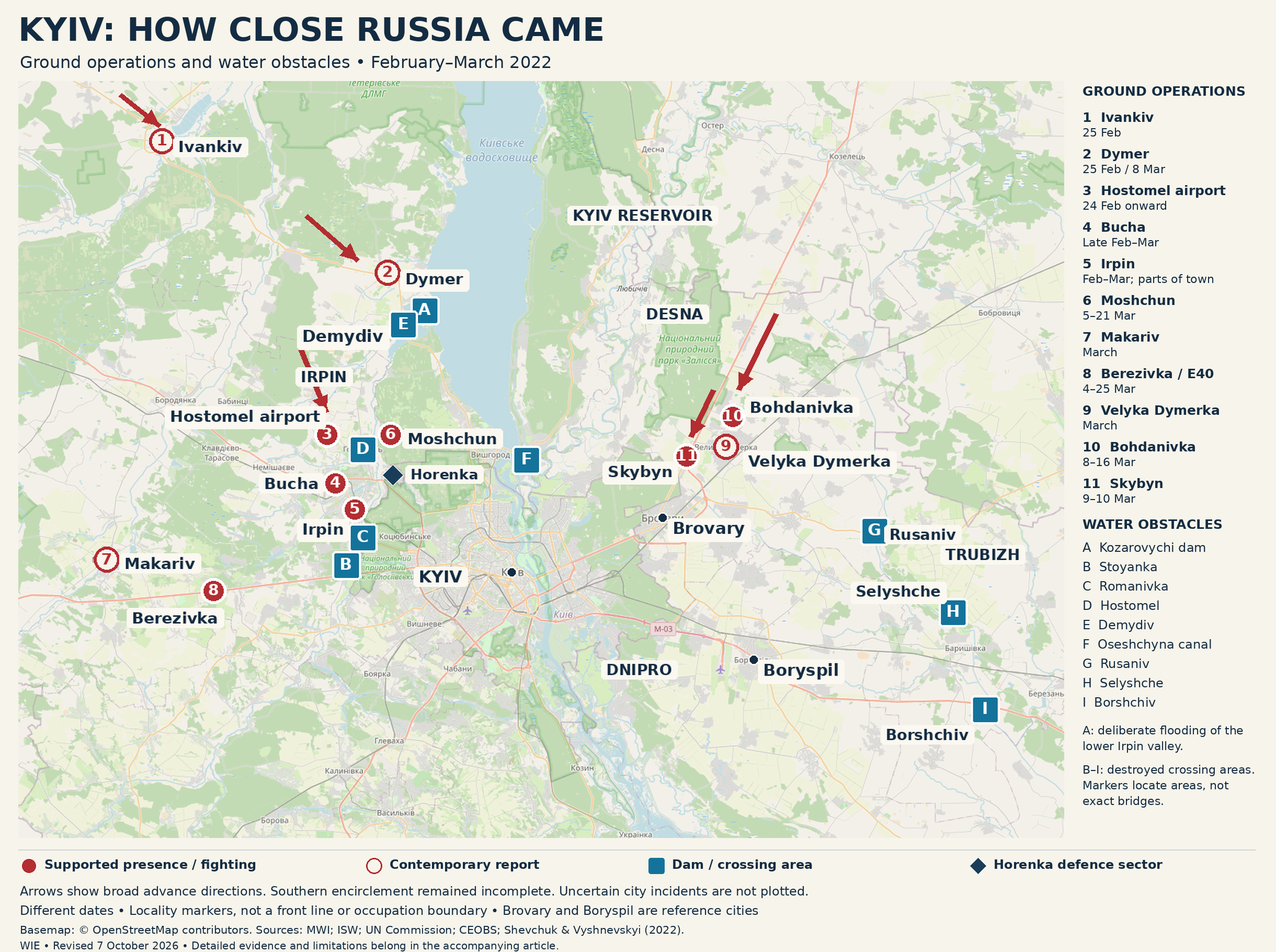
24–26 February 2022
Russia sought a rapid seizure of Kyiv and the collapse of Ukraine’s leadership. This was the opening operation against the capital, not proof that the entire war had been planned to end in three days. RUSI’s reconstruction describes an initial invasion timetable of ten days, followed by occupation. [8–9]
Russian troops advanced towards Kyiv on both sides of the Dnipro. Early fighting around Ivankiv and the destruction of the Teteriv bridge complicated the northwestern approach. The capital’s defence depended on slowing the attackers before they could concentrate near its political centre. [29]
On 24 February, Russian airborne troops landed at Hostomel Airport, also known as Antonov Airport. These are two names for the same site. Russia intended to use it to bring in reinforcements and support a rapid advance. Ukrainian resistance prevented the intended air bridge, even though Russian forces subsequently held the airport. [8]
Ukraine’s defence included an outer ring in the suburbs and an inner ring within Kyiv. Regular soldiers, territorial defence, police and volunteers contributed to resistance. [8,30]
The difference between an air attack and a ground breakthrough matters. Ukraine’s airports and infrastructure were attacked, but explosions did not establish Russian control on the ground. Early claims of a major Russian landing at Vasylkiv remain less securely evidenced than the assault at Hostomel. [31]
A week in: Kyiv was dangerously close to the battle
Late February–early March 2022
Russian troops reached Hostomel, Bucha and the approaches to Irpin. The danger was immediate: major fighting was taking place in the capital’s neighbouring communities, not on a distant frontier. Russian attempts to widen the offensive westwards also threatened the roads that connected Kyiv with the rest of Ukraine. [8,32]
Inside Kyiv, authorities reported Russian infiltrators in Obolon on 25 February. Reports also identified shooting near Ovrutska Street in Lukianivska and fighting around Beresteiska. These accounts show the insecurity of the first days, but their evidential strength varies. They do not establish Russian occupation of those neighbourhoods or a continuous advance into the centre. [33]
The long Russian vehicle column north of Kyiv showed the scale of the concentration behind the leading forces. A convoy, however, is not a front line. Vehicles assembled on a road do not automatically control the surrounding territory or constitute a functioning assault force.
Russia had brought war to the capital’s doorstep. It had not produced the political collapse on which its rapid campaign depended. Ukraine’s government remained in place, while military resistance gave civilian mobilisation time to develop.
The rivers, bridges and villages that helped Kyiv hold
March 2022
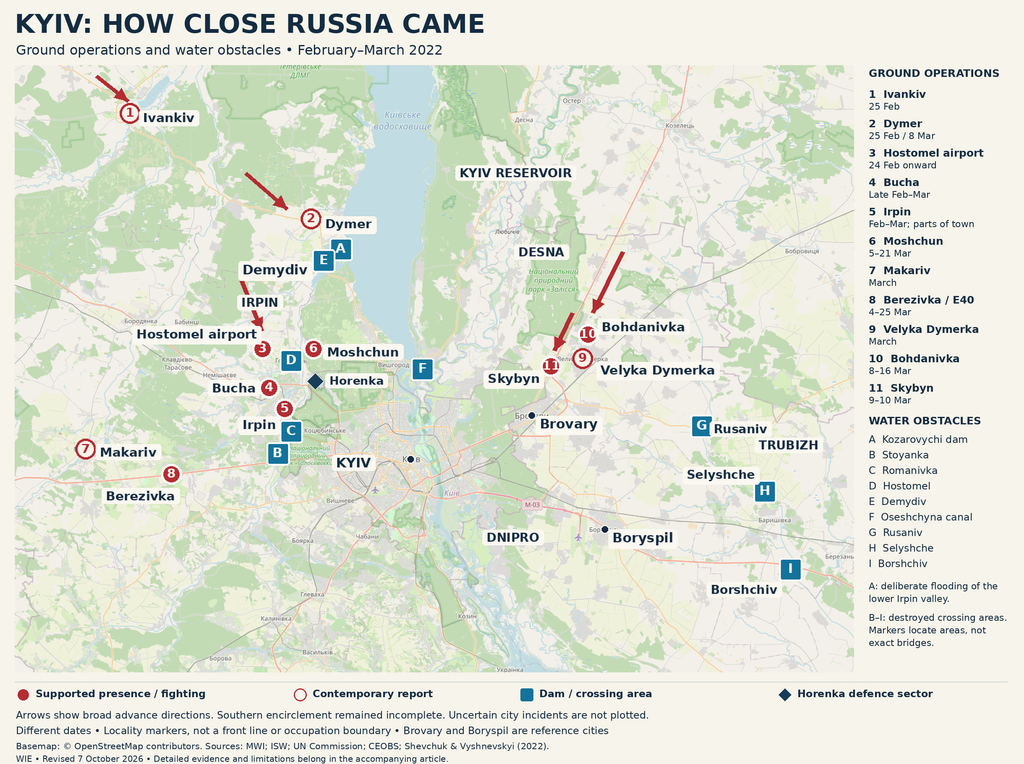
The Irpin River formed a defensive obstacle west and northwest of Kyiv. Destroyed crossings restricted the roads available to heavy vehicles. Ukrainian defenders could concentrate on likely crossing points rather than defend every approach equally. Stoyanka, Romanivka, Hostomel and Demydiv were important parts of this geography. [27–28]
At Kozarovychi, where the Irpin meets the Kyiv Reservoir, Ukrainian defenders breached the dam. Reservoir water flowed into the lower Irpin valley and flooded fields and homes around Demydiv. The opening was enlarged later, and the flooded area expanded through March. The dam was at Kozarovychi, not in Dymer. [27]
The flooding was a deliberate defence measure with real civilian costs. It made crossings and vehicle movement harder, but it did not create an immediate, impenetrable wall along the entire river. [27]
Russian troops crossed near Rakivka around 5–6 March and fought in Moshchun. Heavy combat continued later in the month; 6 March was not the end of the battle. Horenka was another important defended crossing sector. Fighting, destroyed bridges and rising water together helped deny Russia a reliable breakthrough towards Kyiv. [8,27]
The eastern approach faced a different combination of obstacles. The defence of Chernihiv delayed Russian forces before they reached Kyiv’s northeastern outskirts. In March, Russian vehicles and troops were reported around Bohdanivka and Velyka Dymerka. At Skybyn, north of Brovary, a Russian armoured advance was repelled on 9–10 March. This does not mean Russia captured Brovary. [8,32,34]
Destroyed bridges over the Trubizh at Rusaniv, Selyshche and Borshchiv, and the canal crossing near Oseshchyna, also disrupted the road network. These belong on a map of defensive obstacles. Their destruction alone does not prove Russian troops reached each crossing. [28]
Kyiv was threatened from several directions, but the encirclement remained incomplete. Russian forces did not establish a continuous blockade across the southern approaches. Russia’s offensive was becoming a prolonged fight against an organised defence, exposed supply routes and terrain it could not quickly overcome. [32]
The retreat: Kyiv survives, but the war continues
Late March–early April 2022
Ukrainian attacks on Russian positions and logistics increased the pressure around the capital. Artillery was especially important in preventing the seizure of Kyiv, alongside infantry, anti-tank weapons, reconnaissance and local knowledge. The victory cannot be reduced to one weapon, one flooded river or one stalled convoy. [9]
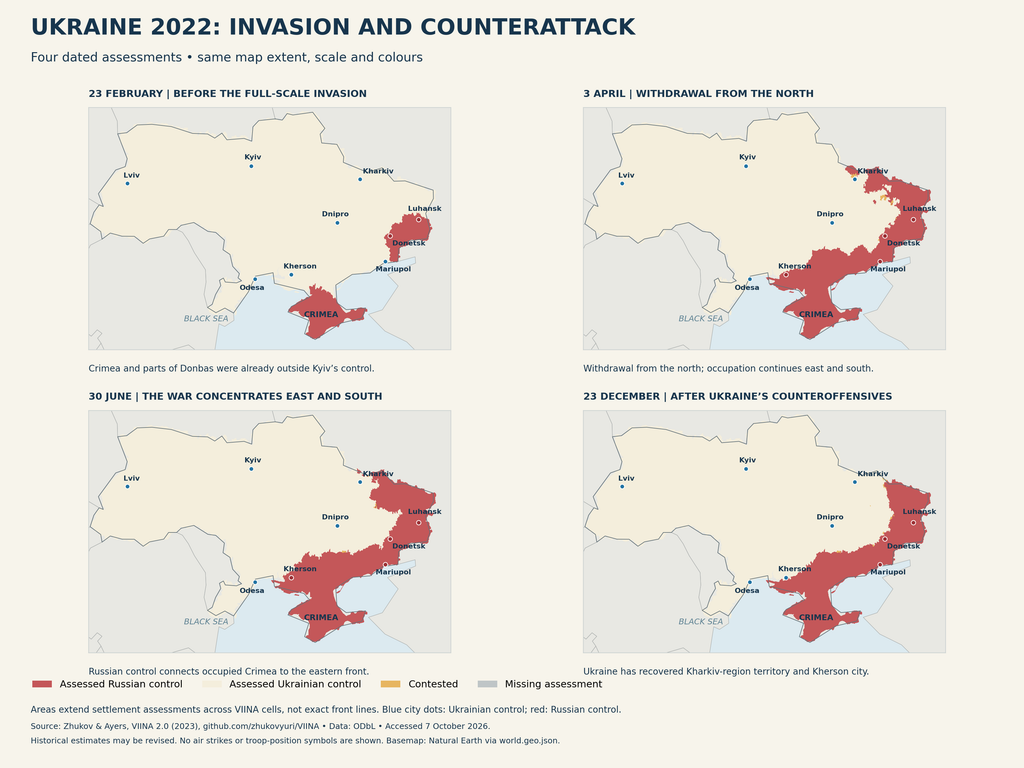
By early April, Russian forces had withdrawn from the Kyiv, Chernihiv and Sumy regions. Ukraine had defeated the opening attempt to overthrow its independent government. It had not driven Russia back to the front lines that would prevail through the following years: large parts of the east and south remained occupied.
This distinction matters. Kyiv’s survival was a strategic victory, but the occupation elsewhere and the redeployment of Russian forces meant that a longer war was beginning.
Bucha: what occupation meant
UN investigations documented civilian killings and summary executions in Bucha and other occupied communities across northern Ukraine. The withdrawal exposed what occupation had meant for people who could not escape. Documented counts were minimum verified findings, not complete death tolls. [10]
Bucha did not represent a late deterioration from an initially lawful campaign. Severe abuses were present from the beginning.
There were precedents. Human Rights Watch documented mass civilian killings by Russian forces in the Grozny suburbs of Aldi and Chernorechie in February 2000. Different circumstances do not erase the recurring problems of abuse and impunity. [11]
Later UN investigations documented widespread and systematic torture of Ukrainian civilian detainees by Russian authorities, along with executions of captured soldiers and sexual violence. Ukrainian violations have also been documented and require accountability; they do not erase the scale and organisation of Russian abuses. The ICC issued arrest warrants for Putin and Maria Lvova-Belova over alleged unlawful deportation and transfer of Ukrainian children. Warrants are not convictions. [12–14]
The lesson for Europe was practical as well as legal. International law provides standards and a basis for accountability. It cannot, by itself, protect civilians from an occupying force willing to violate those standards.
Three months in: the war moves east and south
April–July 2022
After leaving northern Ukraine, Russia concentrated on the Donbas and the south. Kyiv was safer, but Ukraine’s position elsewhere remained dangerous.
Russian forces had captured Kherson during the opening campaign. Mariupol endured a devastating siege, ending with the surrender of the remaining Azovstal defenders in May. Russia consolidated a land corridor to occupied Crimea.
In the Donbas, concentrated artillery and sustained assaults placed Ukraine under intense pressure. Sievierodonetsk fell in late June, followed by Lysychansk in early July. Russia pursued territorial gains through firepower and attrition after its rapid campaign against Kyiv had failed. [9,15]
After approximately three months, two realities existed together: Ukraine had preserved its state, while Russia could still capture territory and devastate cities. Western ammunition and equipment were becoming essential to sustaining resistance.
Ukraine strikes back
July–December 2022
The second half of 2022 brought another change in momentum. Western-supplied precision systems, including HIMARS, helped Ukraine strike Russian logistics and command facilities.
In September, a Ukrainian offensive broke through in the Kharkiv region, recovering towns including Izium and Kupiansk. Surprise and manoeuvre produced gains that months of static fighting had not.
Around Kherson, pressure on crossings and supply routes weakened Russia’s position west of the Dnipro. Russian forces withdrew from the city and western bank in November. [15]
Russia mobilised additional personnel, claimed the annexation of four Ukrainian regions it did not fully control, and intensified attacks on Ukraine’s energy system.
By year’s end, Ukraine had demonstrated that it could reverse Russian gains. But victory around Kyiv, Kharkiv and Kherson did not guarantee the rapid recovery of all occupied territory.
The breakthrough that did not come
2023
Russia captured Bakhmut in May after a prolonged and destructive battle. Across the south, it strengthened minefields, trenches and defensive positions.
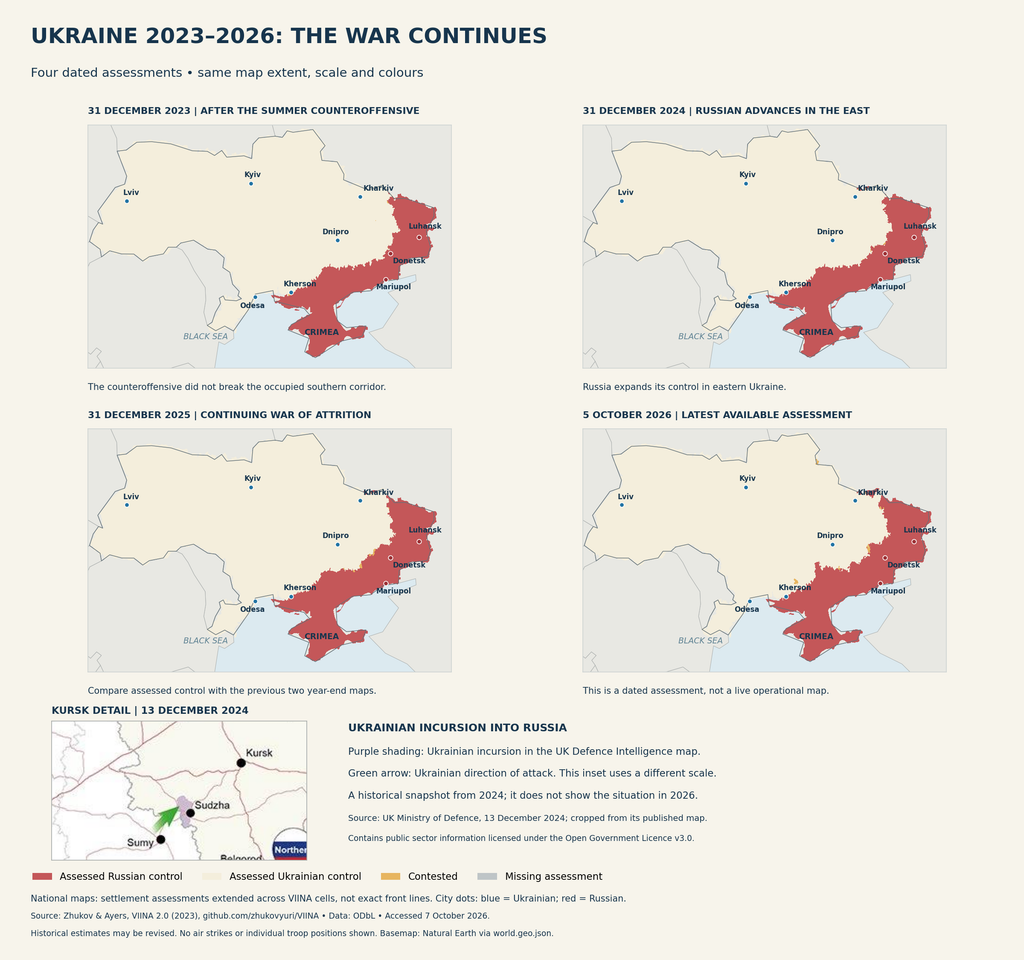
Ukraine’s major counteroffensive began in June. A central ambition was to break through towards the Sea of Azov and disrupt Russia’s land corridor. That breakthrough did not occur.
Extensive minefields, Russian firepower, limited air protection and difficulties coordinating operations constrained progress. Ukraine adapted and made local gains, but could not reproduce the speed of the Kharkiv offensive. RUSI’s research identifies mine reconnaissance, training, ammunition and repair capacity among the practical constraints. [16]
Ukraine also increased pressure on Russian naval operations through missiles and unmanned systems. The balance in the Black Sea could change even when the land front moved only slowly.
Russia increases pressure — Ukraine crosses the border
2024
Russia captured Avdiivka in February and opened another offensive in the northern Kharkiv region in May. Ukraine faced shortages of personnel and ammunition, while uncertainty in external support complicated planning.
Russian forces adapted their assault methods and increasingly used drones, electronic warfare and glide bombs. Ukraine adapted in turn. Surveillance and precision attacks made movement more dangerous for both sides. [17]
In August, Ukraine launched a surprise incursion into Russia’s Kursk region. It showed that Russian territory was not immune from the war Moscow had started, but success there did not automatically remove pressure in the Donbas. Ukraine had to sustain both commitments. [18]
By year’s end, Russia had made further gains in eastern Ukraine. Ukraine retained the capacity for unexpected operations, but the contest of resources remained unresolved.
Attrition brings further Russian gains
2025
In spring 2025, Ukraine lost most of the territory it had seized in Kursk. Along the main front, its personnel shortages remained serious, while drones helped impose costs on Russian assaults. [19]
Russia adapted its drone operations, attacks on supply routes and small-group assaults. ISW’s year-end assessment found greater Russian territorial gains in Ukraine than in 2024, while noting that Moscow still had not achieved its principal territorial objectives. These were assessed gains, not a comprehensive audited measure of control. [20]
The picture was therefore neither a frozen front nor a decisive Russian breakthrough. Ukraine continued resisting, but resistance did not prevent every loss.
By autumn 2026: the war is also an industrial contest
By autumn 2026, the war remained unresolved. In September, a Ukrainian commander reported a local offensive operation in northern Donetsk. Reuters could not independently verify his claims. The report indicates continuing Ukrainian initiative, but does not establish a decisive change across the front. [21]
The wider contest extended through cities, energy systems, transport and production facilities. Long-range missiles and drones made distance from the front an uncertain protection.
Air defence remained urgent. At their September meeting, EU defence ministers highlighted immediate deliveries, production capacity and closer cooperation with Ukrainian industry. [22]
Russia’s opening campaign had failed, but its capacity to continue the war remained dangerous. Ukraine had preserved independence, but securing it required soldiers, industrial output, finance and sustained external support.
Europe’s response: from donations to sustained defence
Europe responded rapidly with weapons, sanctions, training, financial support and help for refugees. Some governments had supplied equipment before the invasion. The problem was not an absence of action, but the difficulty of sustaining it at the scale Ukraine required.
Limited stocks, slow production, fragmented procurement and disputes over escalation repeatedly constrained deliveries. Equipment was useful only when it arrived with ammunition, trained crews, maintenance and replacement capacity.
The first two years exposed the difference between announcing support and building the capacity to deliver it. Europe increasingly had to move from emergency transfers towards a sustained defence effort.
Sweden and Finland nevertheless demonstrated how quickly strategic assumptions could change. Both applied to NATO on 18 May 2022. Finland joined on 4 April 2023, followed by Sweden on 7 March 2024. Russia’s invasion had brought two previously militarily non-aligned states into the alliance. [23]
As the war continued, the question shifted from what Europe could donate to what it could sustainably produce. Supporting Ukraine and rebuilding European defence increasingly became connected tasks.
Ukraine’s defence is part of Europe’s defence
A Russia able to subordinate Ukraine would change the military balance across the continent. Support therefore serves an immediate Ukrainian need and a wider European interest.
Europe is not perfectly united, and it is not synonymous with the EU. Britain, Norway and other partners are important to the wider effort. National priorities differ, but Ukraine’s survival affects the security environment all must inhabit.
The United States has been indispensable through intelligence, weapons and other support. Its interests are nevertheless global and subject to domestic politics. Turkey likewise combines support for Ukraine with relationships with Russia and its own Black Sea priorities. Europe needs the capacity to defend its interests when partners’ priorities differ.
Europe’s own history includes wars among European states as well as threats from outside. The useful historical lesson is therefore specific: Russian and Soviet expansion repeatedly challenged neighbouring societies’ ability to determine their own future.
In June 2026, the European Council explicitly connected support for Ukraine with European defence readiness and called for learning from Ukrainian technological experience. [24]
Build a shared industrial network
The next step must go beyond transferring finished weapons. Ukraine should become a durable part of Europe’s defence-industrial network.
European partners can contribute investment, components, manufacturing capacity and long-term orders. Ukraine contributes engineers, production capabilities and direct experience of equipment under wartime conditions.
Drones illustrate the relationship, but the lesson extends to ammunition, air defence, communications, electronic warfare and repairs. New technology does not replace infantry, artillery or logistics. It increases the need to connect them effectively.
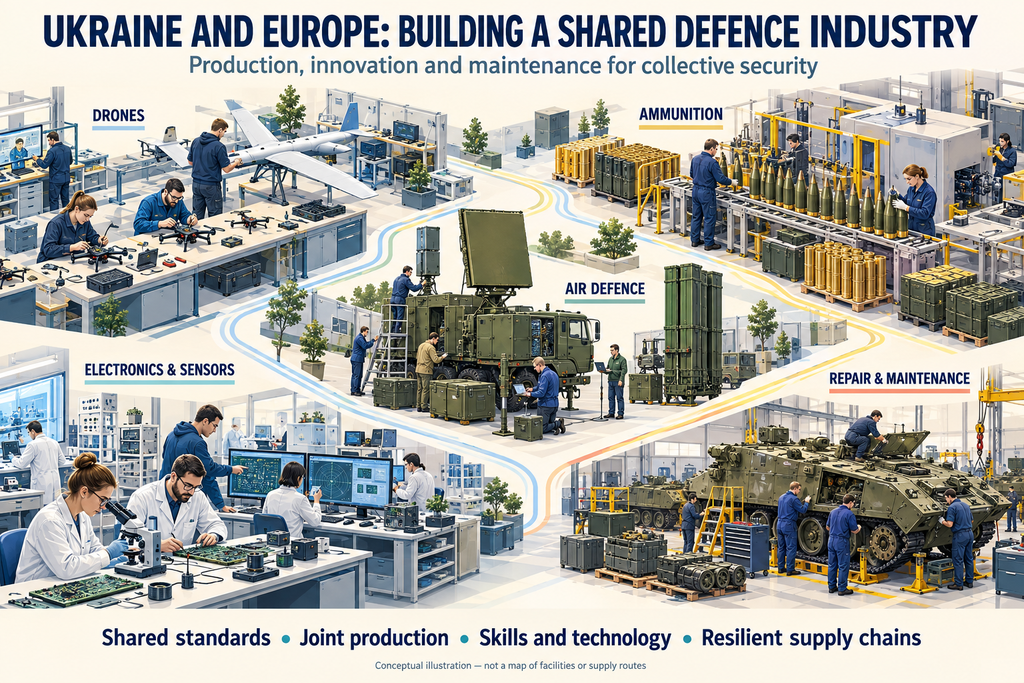
A modern defence system must combine volume with rapid adaptation. Equipment may require modification within weeks, while traditional procurement takes years.
The EU’s defence industry programme includes a €300 million instrument to support Ukrainian industrial capacity and cooperative procurement. It is one mechanism for turning support into a more lasting production relationship. The September 2026 defence ministers’ meeting again emphasised integration of Ukrainian companies into Europe’s industrial base. [22,25]
These are mechanisms, not the final objective. The objective is a connected network able to develop, produce, repair and improve equipment at scale, with Ukrainian companies as lasting partners.
The death of Russkiy mir?
Russkiy mir — the “Russian world” — can describe language, culture and connections across borders. Those connections do not inherently require political domination.
The destructive step is turning them into a claim that Moscow may govern, annex or determine the future of other societies.
The invasion has exposed that claim’s weakness in Ukraine. People can speak Russian and share family connections with Russia while refusing Russian rule. Changing flags, passports or schoolbooks cannot automatically turn occupation into allegiance.
An occupying state must do more than capture land. It needs soldiers, administrators, police, teachers and institutions capable of imposing its authority over time. It may bring in personnel and settlers, recruit local collaborators, rewrite curricula and suppress dissent. Assimilation is a further political project, not an automatic consequence of military victory.
Information, migration, external support and persistent national identity can make forced integration harder. They do not make it impossible. UN reporting documents pressure to accept Russian citizenship and restrictions on Ukrainian cultural expression in occupied territory. Coercion remains powerful, even when genuine allegiance is absent. [13]
Russia can still seize territory, destroy cities and inflict immense suffering. But destruction is not proof of integration.
Our strategic argument is that the war may mark the collapse of Russkiy mir as a credible Russian-led political project in Ukraine. This is an interpretation of the war’s consequences, not a prediction that Russian military power or coercive occupation will disappear.
Ukraine’s survival has changed Europe
The defence of Kyiv prevented rapid political collapse. The later successes around Kharkiv and Kherson showed that Russian gains could be reversed. The following years revealed how difficult further recovery would become against an adapting opponent.
The war exposed occupation practices, changed military technology and revealed Europe’s lack of readiness. Europe began by sending equipment from warehouses; it increasingly needs industrial capacity and political endurance for its own security.
Ukraine is central to that effort. Its people defend their state, its armed forces generate lessons Europe must understand, and its industry can help build a wider system of defence.
The outcome remains uncertain. But one assumption has been decisively challenged: that Russia can claim another population through language and history, invade it, and expect acceptance.
Russia’s military power remains dangerous. Its claim to speak for Ukraine has been broken by Ukrainians themselves.
Updated 7 October 2026
Sources and further reading
Bracketed numbers identify supporting sources. The discussion of Europe’s security and Russkiy mir is strategic analysis. Official statements establish policy positions and attributed claims; they are not independent battlefield verification. Maps require their own dated evidence and geographic checks.
[1] Ukrainian national movement: historical overview — Encyclopedia of Ukraine, History of Ukraine.
https://www.encyclopediaofukraine.com/display.asp?linkpath=pages%5CH%5CI%5CHistoryofUkraine.htm
[2] Stalin, nationalism and comparative repression — Veljko Vujačić, Stalinism and Russian Nationalism (2007); Timothy Snyder, Hitler vs. Stalin (2011).
https://digitalcommons.oberlin.edu/faculty_schol/1035
https://www.nybooks.com/articles/2011/03/10/hitler-vs-stalin-who-killed-more
[3] Independence and public opinion — KIIS, Dynamics of attitudes towards independence (2013–2024); State Archives of Zaporizhzhia, 1991 referendum.
https://www.kiis.com.ua/?cat=reports&id=1427&lang=eng&page=1
https://www.archivzp.gov.ua/uk/l-30-r
[4] Crimea and territorial integrity — UN General Assembly resolution 68/262, 27 March 2014.
https://press.un.org/en/2014/ga11493.doc.htm
[5] Macron’s February assurances — BBC News, 9 February 2022; Reuters, Kremlin denial.
https://www.euronews.com/2022/02/09/us-ukraine-crisis
[6] Televised Security Council meeting — CNN transcript, 21 February 2022; UN Security Council coverage, 23–24 February 2022.
https://transcripts.cnn.com/show/fmjc/date/2022-02-21/segment/01
https://press.un.org/en/2022/sc14803.doc.htm
[7] Sovereignty and commitments — Budapest Memorandum, 5 December 1994, UN Treaty Series; UN Security Council coverage.
https://treaties.un.org/Pages/showDetails.aspx?objid=0800000280401fbb
https://press.un.org/en/2022/sc14803.doc.htm
[8] Opening battle for Kyiv — Liam Collins and John Spencer, Modern War Institute, 21 February 2025.
[9] Early military campaign — Zabrodskyi et al., RUSI, Preliminary Lessons in Conventional Warfighting, 30 November 2022.
https://static.rusi.org/359-SR-Ukraine-Preliminary-Lessons-Feb-July-2022-web-final.pdf
[10] Bucha and civilian killings — OHCHR, 7 December 2022.
[11] Chechnya precedent — Human Rights Watch, February 5: A Day of Slaughter in Novye Aldi, June 2000.
https://www.hrw.org/reports/2000/russia_chechnya3/chech-summary.htm
[12] Civilian detention and torture — OHCHR, Treatment of civilians deprived of liberty, 23 September 2025.
[13] POWs, occupation and citizenship — OHCHR, Report covering 1 December 2024–31 May 2025, 30 June 2025.
[14] Children and arrest warrants — ICC, 17 March 2023.
[15] 2022–23 offensive operations — RUSI, Preliminary Lessons from Ukraine’s Offensive Operations, 2022–23 (2024).
https://static.rusi.org/lessons-learned-ukraine-offensive-2022-23.pdf
[16] 2023 counteroffensive constraints — Jack Watling and Nick Reynolds, RUSI, Stormbreak, 4 September 2023.
[17] 2024 tactics — Jack Watling and Nick Reynolds, RUSI, Tactical Developments During the Third Year, 14 February 2025.
[18] Kursk operation — RUSI, Decoding Kursk, 21 August 2024.
https://www.rusi.org/explore-our-research/publications/commentary/decoding-kursk-end-sight-ukraine
[19] Spring 2025 battlefield — Jack Watling, RUSI, 20 May 2025.
[20] End-of-year 2025 assessment — ISW / Critical Threats, 31 December 2025; estimates, not audited totals.
https://www.criticalthreats.org/analysis/russian-offensive-campaign-assessment-december-31-2025
[21] September 2026 operation — Reuters, 15 September 2026. Ukrainian commander’s account; Reuters could not independently verify the claims.
[22] September 2026 defence requirements — Council of the EU, Foreign Affairs Council (Defence), 28 September 2026.
https://www.consilium.europa.eu/en/meetings/fac/2026/09/28
[23] NATO accession dates — NATO, Member countries.
https://www.nato.int/en/about-us/organization/nato-member-countries
[24] European strategic and industrial response — European Council conclusions, 18 June 2026.
[25] Ukraine support instrument — Council of the EU, EU military support for Ukraine.
https://www.consilium.europa.eu/en/policies/military-support-ukraine
[27] Irpin flooding and dam chronology — CEOBS, Examples of environmental harm in Ukraine: Irpin Dam.
[28] Rivers and destroyed crossings — Shevchuk & Vyshnevskyi, Use of Water Bodies for the Defense of Kyiv, conference paper, November 2022.
https://doi.org/10.3997/2214-4609.2022580029
[29] Ivankiv and Dymer, early fighting — Ukrainian government situation report, 25 February 2022, 06:00. Contemporary official account.
[30] Kyiv’s two defensive rings — Washington Post, Battle for Kyiv: How Ukrainian forces defended and saved their capital, August 2022. Interview-based reconstruction.
https://www.washingtonpost.com/national-security/interactive/2022/kyiv-battle-ukraine-survival
[31] Vasylkiv: uncertainty surrounding early landing claims — The Guardian, 28 February 2022.
[32] Axes of advance and reported presence — ISW, assessments 8 and 16 March 2022.
https://understandingwar.org/research/russia-ukraine/russian-offensive-campaign-assessment_8-31
https://understandingwar.org/research/russia-ukraine/russian-offensive-campaign-assessment_16-32
[33] Kyiv city incidents — Ukrainska Pravda, 25–26 February 2022; LB.ua, 25 February. Contemporary reports with attribution limitations.
https://www.pravda.com.ua/eng/news/2022/02/25/7325681
https://en.lb.ua/news/2022/02/25/9222_kyiv_enemy_diversion.html
https://www.pravda.com.ua/eng/news/2022/02/26/7326009
[34] Skybyn/Brovary armoured column — Sky News, geolocated video analysis, 10 March 2022.
[35] Territorial control data for the 2022 and 2023–2026 maps — Yuri M. Zhukov and Natalie Ayers, VIINA 2.0 (2023), Violent Incident Information from News Articles. Daily settlement-level control assessments; data licensed under the Open Database Licence (ODbL). Map areas extend these assessments across geographic cells and do not represent exact front lines. Accessed 7 October 2026.
Leave a Reply