
From 10000 BC to AD 1000
How migration, language, religion and trade formed Europe’s early regions
How did a continent of small hunting and farming communities become a world of kingdoms, cities and connected regions?
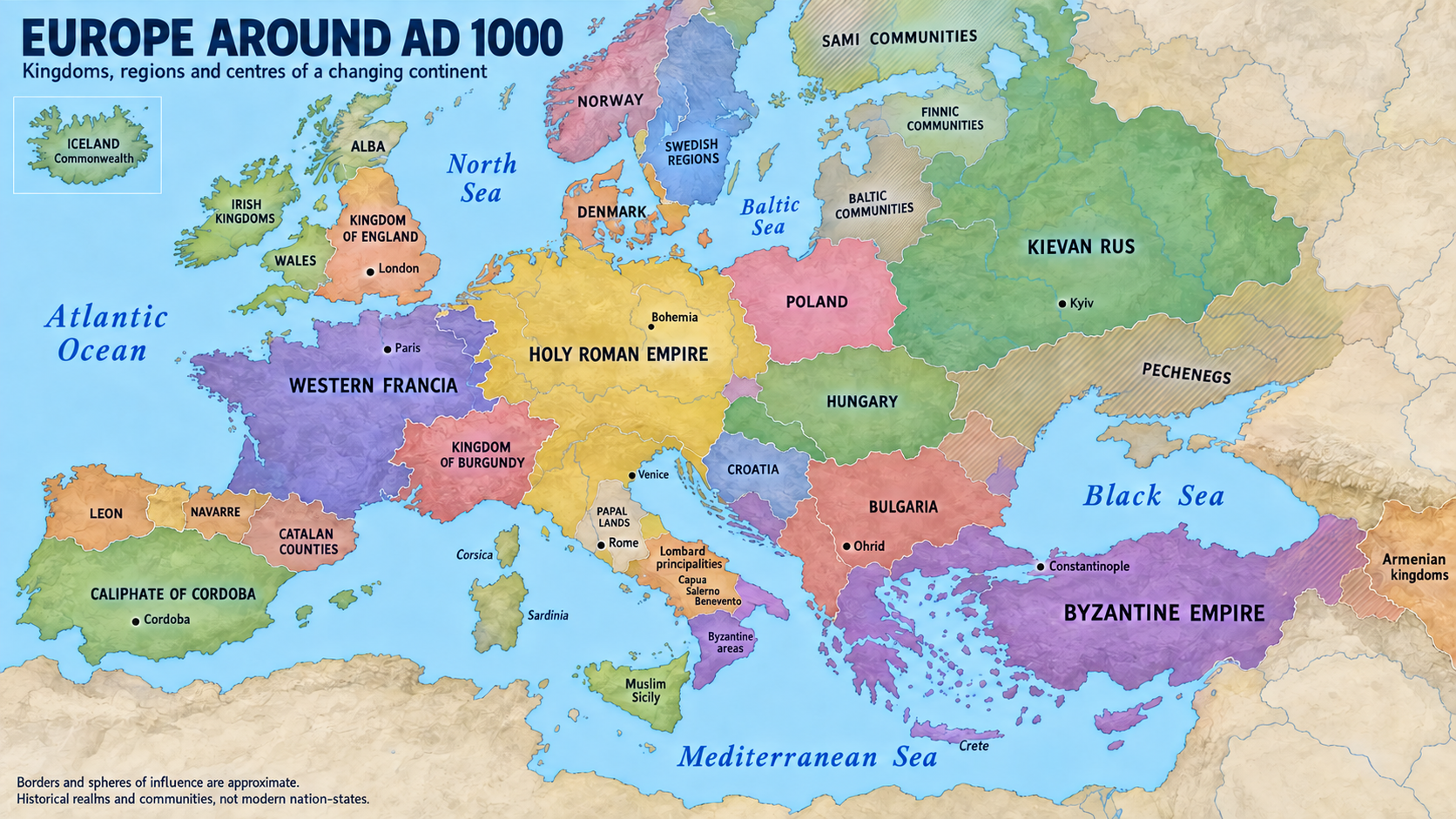
By AD 1000, parts of Europe were beginning to look familiar. England had become a kingdom; western Francia was developing into France; an emperor ruled across German and Italian territories; and new political centres were consolidating in Scandinavia, Poland, Hungary and Rus. Constantinople and Córdoba remained among the continent’s great centres.
None of this followed a single plan. Europe took shape through population movements, changing languages, the expansion and fragmentation of empires, and connections between regions. Its inhabitants repeatedly adapted institutions and technologies inherited from others.
To understand that transformation, we need a short look at its prehistoric foundations, followed by a closer examination of the centuries when its later regions emerged. Dates are approximate, and the transitions occurred at different times across the continent.
The foundations of European society
Around 10,000 BC, Europe was approaching the end of the last glacial period. Warming opened northern landscapes to settlement, forests expanded and rising seas changed the coastline. The gradual flooding of Doggerland separated Britain from continental Europe. Rivers, coasts and lakes supplied food and provided routes between communities. [1]
Europe’s hunter-gatherers were regionally diverse. Their languages are largely unknown, and their beliefs can only be partly reconstructed from burials and objects. They nevertheless possessed sophisticated tools, boats and knowledge of their environments. [2]
The next major transformation arrived through agriculture. From approximately 7000 BC, farmers with roots in Anatolia established settlements in the Aegean and Balkans. Farming spread through the Danube corridor and along Mediterranean coasts, reaching Britain and Ireland around 4000 BC. Ancient DNA shows that migration was central to this process, accompanied by varying degrees of mixture with local populations. [3, 4]
Fields, livestock and stored food supported larger populations and more permanent settlements. They also changed power: access to land and accumulated resources could be inherited or controlled. Households remained the basis of production, while communities organised larger building projects and specialised crafts.
These developments established Europe’s agricultural foundations. They also demonstrated the importance of southeastern Europe as a gateway connecting the continent with southwest Asia.
Migration metals and early networks
During the fourth and third millennia BC, connections with the grasslands north of the Black and Caspian seas became increasingly important. Mobile herding economies, wheeled transport and extensive social networks supported population movements into farming regions farther west.
Communities associated with Yamnaya and later Corded Ware were central to the spread of steppe ancestry. Bell Beaker networks accompanied further population changes in some regions. These archaeological labels describe patterns of material culture; they should not be treated as the names of uniform ethnic populations. [5, 6]
The movements also help explain the spread of some Indo-European languages, ancestors of Greek, Latin, Celtic, Germanic, Baltic and Slavic branches. The relationship between migration and language is strongly supported in broad outline, but particular routes and the family’s deeper origins remain debated. DNA identifies population relationships, not the language an individual spoke. [5, 7]
Meanwhile, copper and then bronze created new economic connections. Bronze production generally required copper and tin, which were unevenly distributed. Atlantic mining regions, Alpine communities, Central Europe, Scandinavia and the Mediterranean participated in overlapping exchange networks. Metals, amber and prestigious objects moved between them. [8, 9, 10]
In the Aegean, Minoan and Mycenaean palace societies concentrated resources and administrative authority. Mycenaean Linear B records an early form of Greek and the management of goods and labour. [27] Elsewhere, influential households and regional elites organised farming, exchange and armed power without comparable written bureaucracies.
Around 1200 BC, many eastern Mediterranean palace systems collapsed. Warfare, political instability and environmental pressures probably interacted, although their relative importance remains uncertain. Other European regions followed different trajectories. By approximately 1000 BC, older networks were being reorganised and iron was becoming increasingly important.
The peoples and cities of Iron Age Europe
During the first millennium BC, iron tools and weapons spread unevenly across Europe. Bronze remained valuable, but iron broadened the possibilities for local production where ore, fuel and technical knowledge were available. Changes in farming, craft production and armed competition accompanied its adoption. [11]
Phoenician traders and settlers connected the eastern Mediterranean with North Africa, Iberia and Mediterranean islands. Greek settlements extended to southern Italy, Sicily and the Black Sea. Access to land, resources and trade encouraged movement, while political disputes also prompted people to leave their home communities.
Writing changed the transmission of knowledge and the exercise of authority. Greeks adapted a Phoenician alphabet; related developments contributed to Etruscan and Latin writing. [26] In trading settlements and cities, records and coinage gradually supported more complex institutions.
Written sources make Greeks, Etruscans, Italic peoples, Celts, Thracians and Scythians increasingly visible. Germanic-speaking communities developed farther north, while Baltic and other linguistic traditions continued in the northeast. These groups contained many communities and political divisions, rather than resembling modern nations.
Hallstatt and La Tène networks linked powerful communities in Central and western Europe. Mediterranean cities, inland settlements and steppe societies formed different centres of influence. Europe’s future diversity was already apparent in the coexistence of urban economies, agricultural communities and mobile pastoral societies.
Greece and the rise of Rome
Greek city-states developed different arrangements for political authority, including oligarchy, tyranny and democracy. Citizenship created strong local identities, but generally excluded women, enslaved people and many residents from political participation.
Agriculture sustained these cities, while ports, craft production and maritime commerce connected them to distant markets. Coinage supported exchange and public payments. Shared gods, festivals and the Greek language linked communities that remained politically divided.
Greek became a major language of literature, philosophy and inquiry. Alexander’s conquests in the fourth century BC extended its influence across the eastern Mediterranean and western Asia. Europe’s intellectual development was therefore intertwined with territories beyond its geographical boundaries.
Rome expanded through conquest, alliances and settlement. Its republic first consolidated authority in Italy and then across much of the Mediterranean. Roads and changing forms of citizenship helped integrate territories, while tribute, taxation and enslaved labour concentrated resources.
The Persian Empire and North African Carthage were major participants in this interconnected world. Rome’s eventual predominance grew from competition and exchange across Mediterranean shores, rather than from an isolated European development.
The Roman world
From 27 BC, imperial Rome connected much of southern and western Europe with North Africa and western Asia. Roads, ports, cities and legal institutions supported administration. Taxation and military spending linked regions with different productive specialisations.
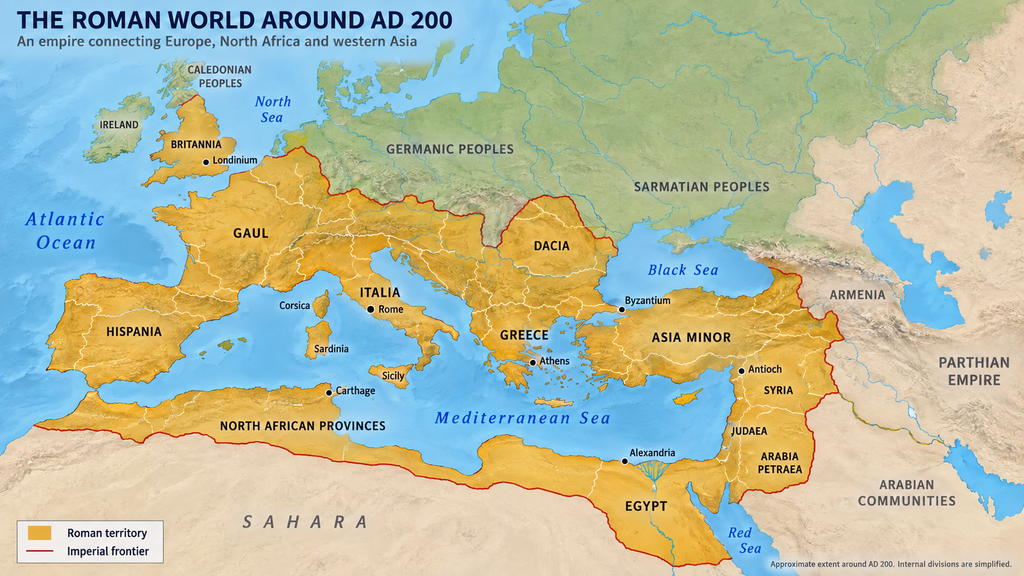
Grain, wine, olive oil, pottery and metals circulated through networks combining commercial markets with state supply systems. Farming remained fundamental, and slavery was deeply embedded. Roman infrastructure and institutions reached communities unevenly, producing distinctive provincial societies rather than a uniform continent. [12]
Language changed alongside administration and settlement. Latin gained ground in western provinces, while Greek remained central in the east. Regional forms of spoken Latin later developed into Romance languages. Beyond the imperial frontiers, Germanic and other languages persisted, although trade and military service brought their speakers into sustained contact with Rome.
Religion also transformed imperial society. Local cults, Roman gods and imported traditions initially coexisted. Jewish communities maintained their own religious networks, and Christianity spread from the eastern Mediterranean. During the fourth century, imperial support helped turn churches and bishops into major public institutions.
Constantinople, inaugurated as an imperial capital in AD 330, strengthened the empire’s eastern centre. Rome’s later political fragmentation would leave two particularly influential inheritances: Latin institutions in the west and a continuing Roman imperial state in the east.
The Migration Period and the making of new kingdoms
Between the late fourth and sixth centuries, population movements and struggles over Roman territory transformed western Europe. This Migration Period was neither one invasion nor a simple replacement of existing populations. Migrating families, military coalitions and new rulers interacted with communities already living within the empire.
Hunnic expansion changed the balance of power on the steppe and intensified pressures farther west. Gothic groups entered Roman territory through combinations of displacement, negotiation and conflict. The crossing of the Danube in 376 and Rome’s defeat at Adrianople in 378 illustrate how efforts to manage migration could turn into military crises. [25]
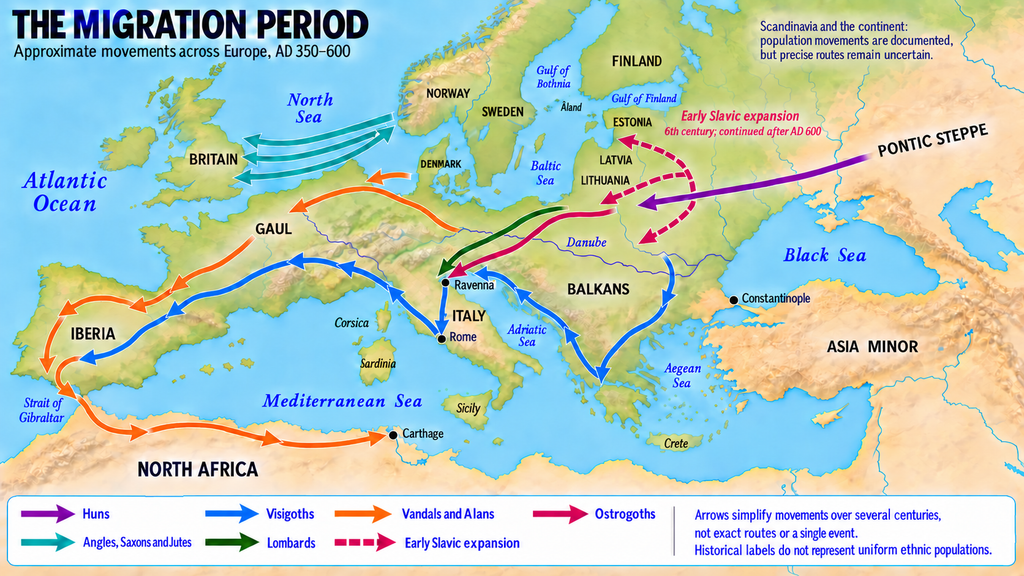
Western imperial authority weakened through civil wars, competing commanders and losses of territory and revenue. The deposition of the western emperor in 476 marks a political turning point, but Roman landowners, towns, churches and legal practices survived under new rulers.
| Groups and movements | Principal areas | Lasting consequences |
| Franks | Gaul and the Rhine region | Frankish kingdoms combined Roman provincial society with new royal and military authority |
| Angles Saxons and related migrants | Britain especially the east and south | Settlement and integration helped establish Anglo-Saxon kingdoms and spread Old English |
| Visigoths | Southern Gaul and Iberia | Successor kingdoms developed within existing Roman provincial societies |
| Ostrogoths and Lombards | Italy | Successive kingdoms reshaped government while Roman institutions and Byzantine territories persisted |
| Vandals and Alans | Across western Europe and into North Africa | Conquests disrupted western imperial control and Mediterranean revenues |
| Huns and later Avars | Steppe and Danube corridors | Military coalitions altered regional power and influenced other population movements |
New rulers depended on local production and often on Roman administrative traditions. The Franks governed a largely Latin-speaking population in Gaul; their rule did not turn the region uniformly Germanic-speaking. In much of eastern and southern Britain, substantial migration accompanied a different outcome: Germanic speech expanded and Old English developed. Ancient-DNA research supports considerable movement from continental northern Europe into early medieval England. [17, 18]
Italy shows why the process cannot be reduced to a map of migrating peoples. Ostrogothic rule was followed by Byzantine reconquest and then Lombard settlement from 568. The peninsula developed a mixture of kingdoms, duchies, imperial territories and papal authority. [19]
Watermills and iron tools continued to support production, while estates and churches organised agricultural labour. In some western regions, weaker taxation and contracting cities increased the importance of landholding and local authority. Byzantine territories retained stronger fiscal institutions and urban connections.
The Migration Period reshaped who ruled Europe and how communities identified themselves. Its consequences depended on the interaction between newcomers and existing populations, with different results for language, law and political organisation.
New languages faiths and centres of power
From the sixth century onward, Slavic-speaking populations expanded across Central and Eastern Europe and the Balkans. Settlement and integration changed the language landscape, while the Avar polity influenced the Danube region. Recent ancient-DNA research supports substantial migration in several studied areas; the emergence of Slavic identities also involved social and cultural change. [13]
Christian institutions connected these changing societies. Western monasteries and bishoprics preserved texts, administered estates and supported royal government. Latin remained a shared written language even as everyday speech diversified. In the east, Byzantine Christianity carried Greek learning and imperial influence beyond the empire’s borders.
Bulgaria became an important state after its establishment in the late seventh century. Its population brought together Bulgars, Slavic-speaking communities and others. Conversion under Boris in the ninth century and Bulgarian literary centres helped establish a durable Slavic Christian tradition. Glagolitic and subsequently Cyrillic writing made Slavic languages vehicles for worship and learning. [20]
Islamic expansion transformed the Mediterranean. Arab and Berber armies established rule in much of Iberia from 711. Al-Andalus connected European territories with North African and eastern markets; Arabic became a major language of administration and learning, alongside continuing local languages and communities. Córdoba grew into a leading cultural centre. [14, 16]
The Frankish empire developed another centre of power. Charlemagne’s coronation in 800 linked his authority with Christian and Roman traditions. Educational reform, manuscripts and ecclesiastical institutions supported government. The division of the empire in 843 contributed to the emergence of separate western and eastern political trajectories. [15]
Scandinavian maritime expansion connected the North Atlantic, British Isles, continental coasts and eastern rivers. Traders, raiders and settlers moved goods and people, including enslaved captives. Their ships made it possible to connect Baltic settlements with routes towards Constantinople and Islamic markets. Rus developed through interaction between Scandinavian elites and local Slavic, Finnic and other communities. [21]
Magyar groups settled in the Carpathian Basin near the end of the ninth century. Their later political consolidation and Christian conversion created the foundations of Hungary. Across these regions, farming supported rulers, while tribute, rents, commercial tolls and access to trade supplied different forms of revenue.
Europe’s centres were multiplying. Constantinople and Córdoba retained strong urban and fiscal institutions; western rulers relied more heavily on estates and regional relationships; northern and eastern centres drew power from settlements, waterways and tribute. No single system governed the continent.
Watermills reduced the labour needed to process grain, while improvements in ships expanded commercial reach. These technologies mattered because they changed what local communities could produce and which markets they could reach.
Europe around AD 1000
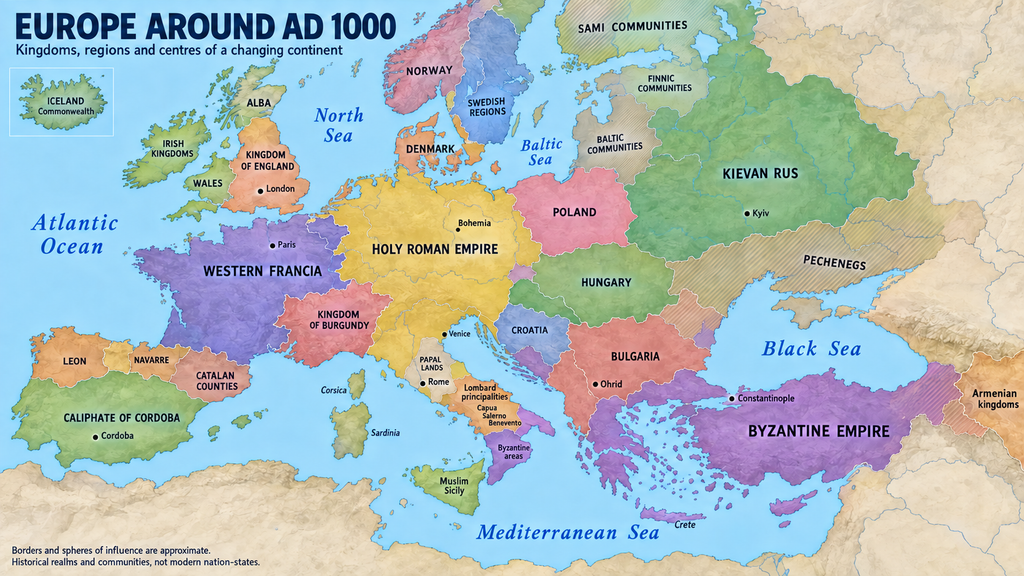
By AD 1000, the results of these transformations were visible in a set of connected regions. These were not modern nation-states, and their boundaries remained unstable. Nevertheless, several political and linguistic patterns would influence later European history.
Western Francia
The western Frankish kingdom provided foundations for France. Hugh Capet’s accession in 987 established a new dynasty, but royal authority remained limited and regional rulers held considerable power. Most people worked the land, and churches and estates organised much economic life. Romance speech developed locally while Latin connected administration and learning. [15]
The Ottonian Empire
Otto I’s imperial coronation in 962 renewed western imperial authority across German and Italian territories. Kings relied on aristocratic relationships and powerful bishops rather than a uniform central administration. Germanic vernaculars and Romance speech coexisted within the realm, while Latin and Christianity connected its institutions. [22]
Italy and the Mediterranean
Italy contained imperial territories, papal lands, Lombard principalities and Byzantine possessions. Venice and southern ports linked these areas to Mediterranean commerce. Muslim Sicily formed part of another maritime world. Roman urban traditions survived alongside competing governments, making Italy a contact zone between Latin Christian, Byzantine and Islamic networks. [19]
Iberia
The Caliphate of Córdoba ruled much of Iberia, while Christian kingdoms and counties controlled territories in the north. Cities, crafts and farming supported their economies, and North African connections remained important. Arabic, Romance varieties, Hebrew and Basque belonged to overlapping linguistic worlds; Muslim, Christian and Jewish communities lived under differing legal arrangements. [16]
Britain and Ireland
England had consolidated under tenth-century rulers, although Scandinavian power remained influential. Royal coinage, fortified settlements and law strengthened government. Elsewhere, Alba, Welsh kingdoms and Irish polities followed distinct paths. Old English, Celtic languages and Norse reflected different histories, while churches and maritime commerce connected communities across the islands. [23]
Scandinavia and the North Atlantic
Denmark and Norway were developing stronger royal institutions, while consolidation in Sweden followed a less uniform course. Farming, fishing and seaborne exchange sustained societies whose religious practices were changing unevenly. Iceland linked Norse-speaking settlers with the North Atlantic, and assemblies remained important alongside royal authority. Iceland’s general assembly was established in 930. [28] Christianity spread without immediately erasing older traditions. [21]
Central Europe
Bohemia and the Piast polity in Poland consolidated around dynasties, fortified centres and churches. Hungary was moving towards Christian kingship, marked by Stephen’s coronation around 1000–1001. [29] Agriculture, tribute and control of routes supported authority. Slavic languages predominated in several areas, while Hungarian preserved a distinct Uralic linguistic tradition. [24]
Byzantium and the Balkans
Constantinople remained an imperial, religious and commercial centre. Taxation, coinage and administration supported a state whose territories extended beyond Europe. Bulgaria remained a major regional power around 1000, amid prolonged conflict with Byzantium. Greek and Slavic Christian traditions connected communities, while farming and urban production supplied their economies. [20]
Rus and the eastern routes
Kyiv and other centres drew power from river corridors connecting the Baltic, steppe and Black Sea. Agriculture, tribute and trade sustained princely authority. Vladimir’s adoption of Byzantine Christianity in 988 strengthened religious and cultural connections with Constantinople. Slavic speech increasingly shaped the political core, alongside Finnic and other communities. Rus cannot be equated with any single modern country. [21]
The Baltic and far north
Baltic-speaking, Finnic and Sámi communities belonged to trading networks without sharing the political structures of the southern kingdoms. Farming mattered in many areas; fishing, hunting and other livelihoods remained central farther north. Local religious traditions continued, and authority rested in varied community and regional arrangements. Their inclusion prevents the story of Europe from becoming exclusively a history of Christian monarchies.
How Europe took shape
By AD 1000, Europe’s history had produced several enduring foundations. Migration and integration shaped populations and languages. Roman government and its successors supplied legal and institutional traditions. Christianity, Islam and Jewish communities connected learning and religious life across political boundaries.
Economic geography gave these developments their regional character. The Mediterranean linked cities and markets; the Rhine and Danube connected inland territories; northern seas supported maritime societies; and eastern rivers linked Europe with the steppe and wider Eurasia. New technologies strengthened particular connections without eliminating geographical differences.
The result was a continent with several centres of authority and exchange. It could preserve inherited knowledge in one region while political power changed in another. That variety offered opportunities for adaptation, although warfare and fragmentation also imposed severe costs.
Europe had not become a unified civilisation or the world’s dominant region. What had emerged was a recognisable set of interacting societies whose kingdoms, languages and institutions would shape the next millennium.
References
References support the historical account and the marked passages. Prehistoric migrations are particularly dependent on archaeological and ancient-DNA research; the early medieval discussion also uses historical and museum syntheses.
[1] British Museum. A timeline of Stonehenge from hunter-gatherers to solstice alignment and beyond. https://www.britishmuseum.org/exhibitions/world-stonehenge/stonehenge-timeline
[2] Posth et al. Palaeogenomics of Upper Palaeolithic to Neolithic European hunter-gatherers. Nature 615, 117–126 (2023). https://doi.org/10.1038/s41586-023-05726-0
[3] Lipson et al. Parallel palaeogenomic transects reveal complex genetic history of early European farmers. Nature 551, 368–372 (2017). https://doi.org/10.1038/nature24476
[4] Mathieson et al. The genomic history of southeastern Europe. Nature 555, 197–203 (2018). https://doi.org/10.1038/nature25778
[5] Haak et al. Massive migration from the steppe was a source for Indo-European languages in Europe. Nature 522, 207–211 (2015). https://doi.org/10.1038/nature14317
[6] Allentoft et al. Population genomics of post-glacial western Eurasia. Nature 625, 301–311 (2024). https://doi.org/10.1038/s41586-023-06865-0
[7] Lazaridis et al. The genetic origin of the Indo-Europeans. Nature 639, 132–142 (2025). https://doi.org/10.1038/s41586-024-08531-5
[8] Moving metals IV Swords metal sources and trade networks in Bronze Age Europe. Journal of Archaeological Science Reports (2019). https://doi.org/10.1016/j.jasrep.2019.05.002
[9] Trading and weighing metals in Bronze Age Western Eurasia (2021). https://pmc.ncbi.nlm.nih.gov/articles/PMC8325268/
[10] Boom and bust in Bronze Age Britain major copper production from the Great Orme mine and European trade c 1600–1400 BC. Antiquity (2019). https://doi.org/10.15184/aqy.2019.130
[11] British Museum. Britain and Europe 800 BC–AD 43. https://www.britishmuseum.org/collection/galleries/britain-and-europe-800-bc-ad-43
[12] British Museum. Roman Britain. https://www.britishmuseum.org/collection/galleries/roman-britain
[13] Ancient DNA connects large-scale migration with the spread of Slavs. Nature 646, 384–393 (2025). https://doi.org/10.1038/s41586-025-09437-6
[14] Metropolitan Museum of Art. The Eastern Mediterranean 500–1000 AD. Heilbrunn Timeline of Art History. https://www.metmuseum.org/toah/ht/06/wae.html
[15] Metropolitan Museum of Art. France 500–1000 AD. Heilbrunn Timeline of Art History. https://www.metmuseum.org/toah/ht/06/euwf.html
[16] Metropolitan Museum of Art. Iberian Peninsula 500–1000 AD. Heilbrunn Timeline of Art History. https://www.metmuseum.org/toah/ht/06/eusi.html
[17] Metropolitan Museum of Art. Western and Central Europe 1–500 AD. https://www.metmuseum.org/toah/ht/05/euw.html
[18] Gretzinger et al. The Anglo-Saxon migration and the formation of the early English gene pool. Nature 610, 112–119 (2022). https://doi.org/10.1038/s41586-022-05247-2
[19] Metropolitan Museum of Art. Italian Peninsula 500–1000 AD. https://www.metmuseum.org/toah/ht/06/eust.html
[20] Metropolitan Museum of Art. Balkan Peninsula 500–1000 AD. https://www.metmuseum.org/toah/ht/06/eusb.html
[21] Metropolitan Museum of Art. Eastern Europe and Scandinavia 500–1000 AD. https://www.metmuseum.org/toah/ht/06/eue.html
[22] Metropolitan Museum of Art. Central Europe including Germany 500–1000 AD. https://www.metmuseum.org/toah/ht/06/euwc.html
[23] The Royal Household. Athelstan 924–939. https://www.royal.uk/athelstan-r924-939
[24] Culture.pl Adam Mickiewicz Institute. Historical Facts about the Baptism of Poland. https://culture.pl/en/article/historical-facts-about-the-baptism-of-poland
[25] Metropolitan Museum of Art. The Roman Empire 27 BC–393 AD. https://www.metmuseum.org/essays/the-roman-empire-27-b-c-393-a-d
[26] Metropolitan Museum of Art. Alphabet Origins From Kipling to Sinai. https://www.metmuseum.org/exhibitions/listings/2014/assyria-to-iberia/blog/posts/alphabet
[27] Metropolitan Museum of Art. Mycenaean Civilization. https://www.metmuseum.org/essays/mycenaean-civilization
[28] Thingvellir National Park. Settlement of Iceland. https://www.thingvellir.is/en/education/history/settlement-of-iceland/
[29] Millennium House Budapest. King Saint Stephen. https://kiallitas.millenniumhaza.hu/en/6/0
Leave a Reply